
Carrollwood · Tampa Bay
Spine Care in Tampa
Neck pain, back pain, and sciatica start with an exam, not a guess.
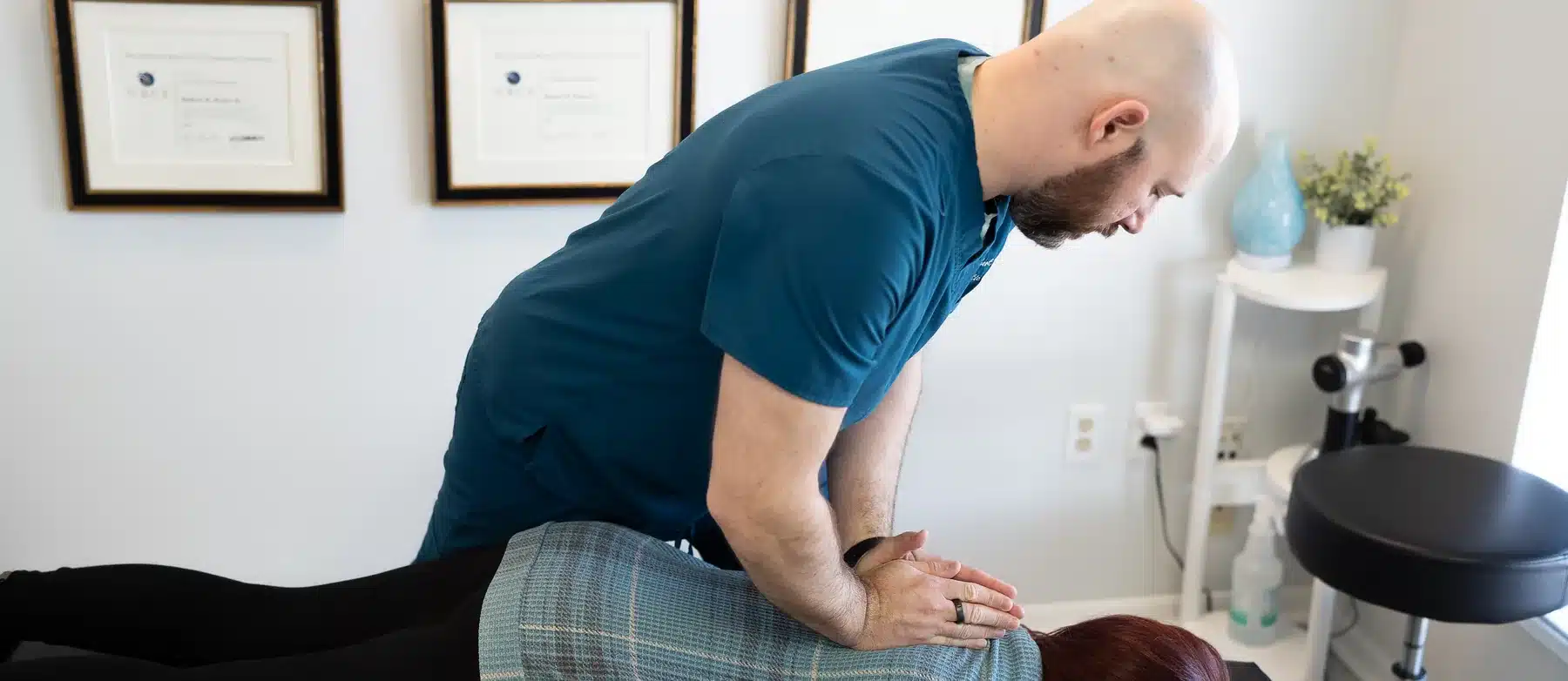
We examine your spine by hand and by how it moves before we decide what to do about it. You see Dr. Bobby Koser, DC, chiropractic physician, at every visit, and you get your findings the same day, explained without the jargon.
Spine Overview
Neck pain
What people notice: stiffness when checking a blind spot, a dull ache at the base of the skull, or pain that builds through a day at a desk. Neck pain often travels: into the head as headaches, or down toward a shoulder blade. We check how your neck moves and where it’s tender before we treat anything. If your neck pain started with a car accident or a fall, our whiplash page covers how that exam is different from a routine neck complaint, and neck-related headaches are covered on our headaches page.
Mid-back pain
What people notice: a band of tightness between the shoulder blades, pain that worsens with a specific twisting motion, or a knot that doesn’t let up with stretching. Patients call it upper back pain or middle back pain; either way it’s the thoracic spine, the stretch between the base of the neck and the bottom of the ribs. We examine your thoracic spine by hand and by testing how it moves under load. Hands-on testing and movement assessment tell us a great deal about what’s driving the pain.

Low back pain
What people notice: an ache after a long day on your feet, a sharp catch bending to tie a shoe, or pain that’s worse in the morning and loosens as you move. Low back pain is the most common reason people book with us. We check how your lumbar spine moves, test reflexes and strength if pain is traveling into a leg, and build your plan around what the exam actually finds. The exam also covers SI joint pain, where the spine meets the pelvis. Tailbone pain is part of it too.
Sciatica and referred leg pain
What people notice: an ache, tingling, or numbness that starts in the low back or buttock and travels down the back or side of the leg, sometimes past the knee. We test which movements bring it on, check reflexes and strength, and work out which level of your spine is involved. Leg pain sometimes traces back to narrowing around the nerve roots. See our spinal stenosis page for how that condition is evaluated. Not every case of leg pain is sciatica, and telling the difference is part of the exam.
Herniated and bulging discs
What people notice: pain that’s worse sitting than standing, pain that increases when bending forward, or an episode that started suddenly while lifting something. A herniated disc in the lower back can send pain, tingling, or numbness down a leg. A herniated disc in the neck can do the same into an arm; the clinical name for that pattern is cervical radiculopathy. People ask about one level by name. L5-S1, the lowest disc in the low back, is the one that comes up most. We look for the pattern in your exam that points toward a disc rather than a joint or a muscle: how bending, sitting, and specific leg positions change what you feel. Our herniated and bulging disc page covers what that exam looks for and how a plan gets built from it.
If your back pain follows a spine operation, whether a recent one or years ago, start at pain after back surgery instead; post-surgical spines are examined differently.
Scoliosis
Scoliosis is a sideways curve of the spine, measured in degrees, and smaller curves often cause no symptoms at all. The full picture, including what a Cobb angle means and when a curve belongs with a specialist, is on our scoliosis page. Plenty of adults learn they have one by accident, on an X-ray taken for something else. When someone with scoliosis comes in hurting, the exam has one main question: is the pain coming from the curve itself, or from a joint or muscle nearby doing extra work because of it? We watch how the curve behaves as you bend and move, and we check the segments around it. Some curves need more than us. A significant curve, or one still progressing in an adolescent, belongs with a physician or an orthopedist, and if that is what your exam shows, we say so. Bracing and correction decisions sit with those specialists.
Stiffness without a clear cause
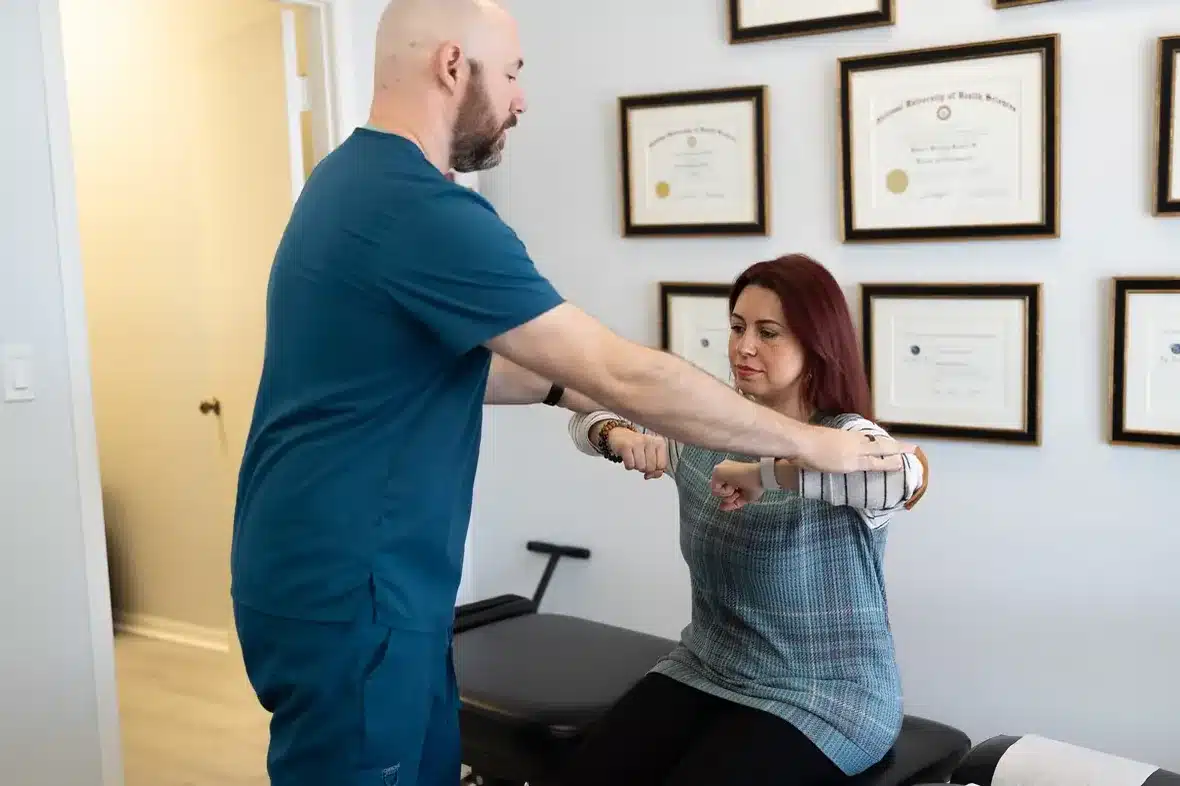
What people notice: a spine that feels locked up first thing in the morning, or that loses range of motion after sitting for a long stretch, with no specific injury behind it. Sometimes stiffness is the whole complaint, with little or no pain alongside it. We check how each segment of your spine moves and build a plan around the segments that are restricted.
How we approach it: exam first, then a plan matched to what we find
- We examine. How your spine moves, where it’s tender, what reproduces your pain, and whether reflexes or strength are affected. On a Pain Source Exam, we may also take a live ultrasound look at the muscles and soft tissue where it hurts.
- We explain. You hear what we found the same day. Not at a second appointment you have to pay for.
- We treat what the exam calls for. A chiropractic adjustment for a joint that isn’t moving the way it should, dry needling to treat trigger points and myofascial pain (pain from tight muscle and its covering) in the muscles involved, or both together in the same visit when that’s what your findings call for. Read more about dry needling in Tampa if muscle tension is part of your picture.
Our goal is for you to need as few visits as possible, and we re-check as we go so you can see what changed rather than guess at it.
What the Research Shows
Spine care here follows the direction the major guidelines already point, cited in full so you can check it yourself.
On chiropractic care. In its 2017 guideline, the American College of Physicians advised clinicians to start with non-drug care for most low back pain, and its recommended options for both new and long-lasting episodes include spinal manipulation, the treatment at the core of chiropractic care.1 Our condition pages for low back pain, neck pain, and sciatica carry the research for each condition in detail.
On acupuncture. The same guideline lists acupuncture among its recommended first-line options for low back pain, with moderate-quality evidence behind it for chronic cases.1 Acupuncture here is its own visit. Dr. Koser is certified in acupuncture by the Florida Board of Chiropractic Medicine.
On staying active. A 2018 series on low back pain in The Lancet urged less imaging, less rest, and fewer opioids, with education and staying active as first-line care instead.2 That is the shape of the plans written here: treat what the exam found, and keep you moving while it settles.
On electrical stimulation. The e-stim used here is most often interferential current, which is a different technology from the TENS unit people buy for home use. A 2022 review of 35 clinical trials found interferential current reduced pain compared with placebo, and found no significant difference between it and the other treatments it was compared against, including TENS.3 An earlier review found it did better than control when added to other care, and did not clearly beat placebo when used on its own.4 That is why it is offered here as an add-on alongside active care rather than as a treatment on its own.
1. Qaseem A, Wilt TJ, McLean RM, Forciea MA; Clinical Guidelines Committee of the American College of Physicians. Noninvasive treatments for acute, subacute, and chronic low back pain: a clinical practice guideline from the American College of Physicians. Ann Intern Med. 2017;166(7):514–530. PubMed
2. Foster NE, Anema JR, Cherkin D, et al; Lancet Low Back Pain Series Working Group. Prevention and treatment of low back pain: evidence, challenges, and promising directions. Lancet. 2018;391(10137):2368–2383. PubMed
3. Hussein HM, Alshammari RS, Al-Barak SS, Alshammari ND, Alajlan SN, Althomali OW. A systematic review and meta-analysis investigating the pain-relieving effect of interferential current on musculoskeletal pain. Am J Phys Med Rehabil. 2022;101(7):624–633. PubMed
4. Fuentes JP, Armijo Olivo S, Magee DJ, Gross DP. Effectiveness of interferential current therapy in the management of musculoskeletal pain: a systematic review and meta-analysis. Phys Ther. 2010;90(9):1219–1238. PubMed
The exam also catches the back pain we should not treat
Most neck and back pain is mechanical: a joint, a muscle, or a disc reacting to movement, posture, or load. A smaller set point somewhere else.
The exam checks that you are in the right office before anything gets treated. Most back pain is chiropractic work. A small number of cases need a medical workup instead, and a few need same-day care. If anything in your history or your exam points that way, we’ll tell you and help you get to the right provider, at the first visit and before any treatment starts.
Go to an emergency room, not to us, if any of this describes you.
- Trouble passing urine, difficulty telling when your bladder is full, or loss of bladder or bowel control
- Numbness in the saddle area between your legs
- New pain or numbness down both legs
- Leg weakness that is getting worse quickly
Get medical care the same day for back pain with a fever, back pain that does not change no matter what position you are in, or back pain with a history of cancer.
If anything in that list sounds like same-day care, go to an emergency room rather than booking. Otherwise, book the exam and we’ll sort it in the room.
If your back pain followed a car accident
Book the Auto Accident Injury Visit, not the Pain Source Exam. It is its own visit, billed to your auto insurance under Florida PIP, and Florida’s PIP law requires that your care begin within 14 days of the crash.
What it costs to start
$195Regular price $330
Self-pay only, one per patient.
Pain has a source. This visit looks for where it is coming from.
- A complete examination with Dr. Koser, which may include a live ultrasound look at the muscles and soft tissue where it hurts.
- Treatment the same visit unless the examination finds a reason it should not: a chiropractic adjustment, dry needling, cupping, laser, or electrical stimulation with infrared, chosen from what the examination finds and what is safe for you.
- Your findings explained the same day.
You’ll leave knowing what we found and what it means. First visit with us, one per patient.
Not ready to begin a membership? Start here and pay as you go. Membership rates apply only under a signed membership agreement. See membership plans.
Self-pay patients only. Not valid with insurance, PIP/auto claims, Medicare, or Medicaid. Injured in a car accident? Book the Auto Accident Injury Visit instead.
THE PATIENT AND ANY OTHER PERSON RESPONSIBLE FOR PAYMENT HAS A RIGHT TO REFUSE TO PAY, CANCEL PAYMENT, OR BE REIMBURSED FOR PAYMENT FOR ANY OTHER SERVICE, EXAMINATION, OR TREATMENT THAT IS PERFORMED AS A RESULT OF AND WITHIN 72 HOURS OF RESPONDING TO THE ADVERTISEMENT FOR THE FREE, DISCOUNTED FEE, OR REDUCED FEE SERVICE, EXAMINATION, OR TREATMENT.
Every other bookable price is on our pricing page.
Common questions
What does a spine exam at HealthSpine include?
A complete examination with Dr. Koser, testing how your spine moves and where it’s tender, reflex and strength testing if pain is traveling into an arm or leg, and, where it will add something, a live ultrasound look at the muscles and soft tissue where it hurts. You get your findings and a plan the same day, explained without the jargon.
Is sciatica the same thing as low back pain?
No. Low back pain stays in the low back. Sciatica and referred leg pain travel: an ache, tingling, or numbness that runs down the back or side of the leg, sometimes past the knee. The exam checks reflexes, strength, and which movements bring the pain on to work out which level of the spine is involved.
What is the difference between a bulging disc and a herniated disc?
A bulging disc pushes outward around a wide part of its rim, and the outer wall stays intact. A herniated disc means inner disc material has pushed out at one spot, where the outer wall has weakened or torn. Both can press on a nerve. Neither automatically explains someone's pain: plenty of people have a bulge or a herniation on imaging and feel fine. That's why the exam matters more than the label.
Do you use ultrasound imaging for back pain?
We may use a live ultrasound look at muscles and soft tissue, most often for neck, low back, and limb muscles. The ultrasound we use is for screening and visual confirmation, not for diagnosing a condition on its own.
When should I see a doctor instead of a chiropractor for back pain?
Most back pain is chiropractic work; a small number of cases need a medical workup instead. If anything in your history or your exam points that way, we'll tell you and help you get to the right provider. That check happens at the first visit, before any treatment starts.
How much does a spine exam cost in Tampa?
The Pain Source Exam is $195 for new patients, an introductory price (regular price $330), one per patient, self-pay only. A regular chiropractic adjustment after that is $60. Our other prices are time-of-service rates, available when you pay in full at the visit. Care billed to a third-party payor, including auto insurance under Florida PIP, health insurance, Medicare, or workers' compensation, is billed on our standard fee schedule without either discount.
 Top 3 Finalist: Best Chiropractor
Creative Loafing Best of the Bay 2025 · Readers Pick
Quoted in National Press
See the coverage →
Top 3 Finalist: Best Chiropractor
Creative Loafing Best of the Bay 2025 · Readers Pick
Quoted in National Press
See the coverage →
This page is general health information and is not medical advice for any individual. The studies summarized describe groups, not any one person’s outcome, and whether a finding explains your symptoms can only be determined by examination. Talk to Dr. Bobby Koser, DC, about your own situation, and seek emergency care immediately for the warning signs described on this page.
Find the source of your back or neck pain.
Book online, or call and we’ll talk it through.
Book Onlineor call 844-51-SPINE (844-517-7463)