
Conditions · Carrollwood · Tampa Bay
Joint Pain in Tampa
Shoulder, elbow, wrist, hip, knee, or ankle: we examine the joint before we treat it.
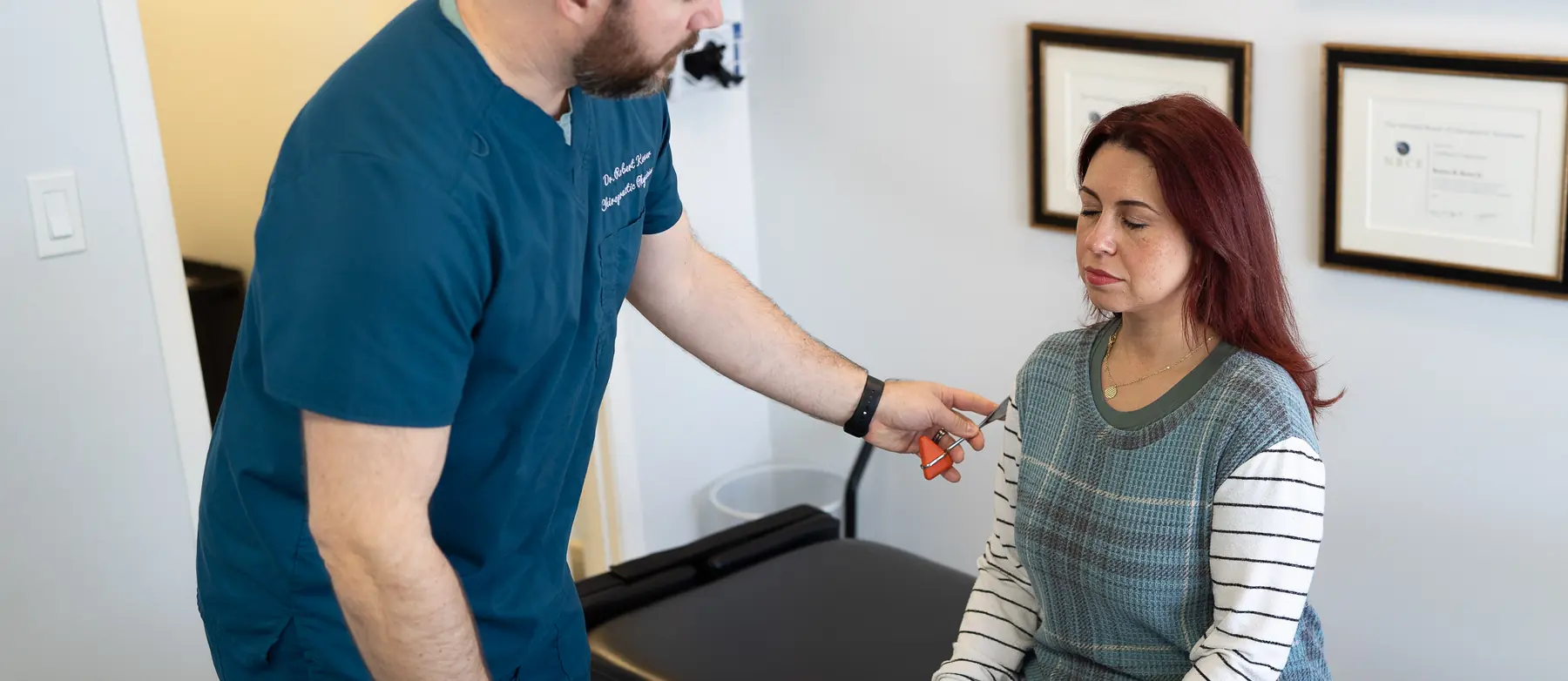
Not every ache in a joint comes from the joint itself. Sometimes it’s the tendon crossing it, the muscle pulling on it, or how you’re loading it during the day. The exam is what tells us which, and that’s what decides your treatment, not the other way around.
Joint Pain Overview
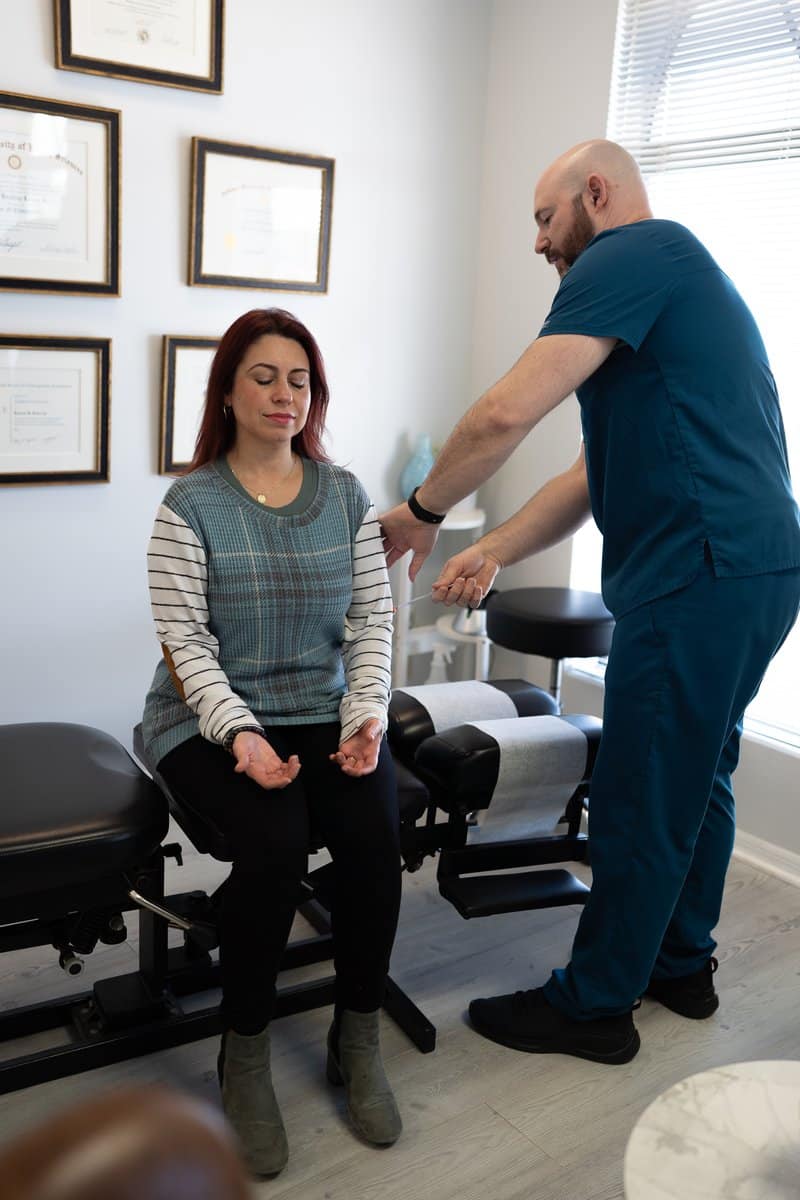
The joints we see most
Some part of your body carries load every day: a shoulder that reaches overhead, a knee that takes stairs, a wrist that types. When one of those starts to hurt, here’s what people usually notice and how we approach it.
Shoulder
People notice it reaching overhead, reaching behind the back, or waking them up when they roll onto it at night. We check the shoulder joint itself along with the neck and the rotator cuff muscles, because shoulder pain often starts somewhere else. Depending on what we find: a chiropractic adjustment, hands-on soft-tissue work, or dry needling for a trigger point in the surrounding muscle. A live ultrasound look is added when the target sits deep enough that feel alone is a guess. More on shoulder pain patterns below.
Elbow
Usually shows up as pain gripping, lifting, or twisting: the outside of the elbow (tennis elbow) or the inside (golfer’s elbow). This is usually the tendon, not the joint itself. The tendon has been asked to handle more load than it was ready for, a pattern doctors call tendinopathy, and the same pattern happens in the shoulder. We examine which tendon is involved and treat the muscle feeding it with dry needling or hands-on work, plus adjustment of the elbow, wrist, or neck when the exam finds restriction there. More detail on this specific pattern is on our tennis elbow page.
Wrist and hand
Aching, stiffness, or a grip that gives out, often tied to repetitive use at a keyboard, a phone, or tools. We examine the wrist and hand by hand, check the neck and forearm for referred causes, and treat with chiropractic adjustment, hands-on soft-tissue work, or dry needling by feel. Ultrasound guidance for the wrist and hand is on hold at this practice right now, so needling here is performed by feel, not by live imaging.
Hip
Deep hip pain, a catch with certain movements, or pain that spreads down the outer thigh. Hip pain is frequently muscular (the glutes and hip flexors) rather than the joint itself, and the exam is what tells us which. Adjustment, hands-on work, and dry needling are all in play, with a live ultrasound look added for a deeper hip muscle when precision matters. More on hip pain at night and bursitis below.
Knee
Pain with stairs, squatting, or after sitting a while, sometimes with swelling. We look at the knee itself and at the hip and ankle above and below it, since a knee often takes the blame for a problem starting elsewhere. Treatment follows the same pattern: adjustment where restriction is found, dry needling for the muscles pulling on the knee, and a live ultrasound look for a deeper target. More on knee pain patterns below.
Ankle and foot
Stiffness, a rolled ankle that never quite settled, or pain in the arch or heel with the first steps in the morning. A sprained ankle fits here too: the exam separates a simple sprain that is settling on its own from one that keeps re-flaring. We check the ankle joint, the calf, and the plantar fascia together. Adjustment, dry needling, and hands-on work are matched to what we find, and a live ultrasound look is added for deeper calf or foot muscle targets. If heel pain specifically is your issue, our plantar fasciitis page covers that pattern in more detail.
Every joint above can involve a nearby tendon, muscle, or ligament. We tell you which structure the exam points to before we treat anything.
Knee pain on stairs, behind the knee, and clicking
Knee pain shows up in patterns, and the pattern is a clue.
- Knee pain going up stairs, or worse coming down: usually the kneecap and the quad that steers it.
- Pain behind the knee: often the hamstring or calf attachments. A knee that will not fully straighten earns a closer look.
- Pain at the outside of the knee, common in runners: often the IT band, the long band of tissue running down the outside of the thigh. It can flare at the outside of the hip as well.
- Clicking by itself is common and usually painless. Clicking with pain or swelling earns a closer look.
Our exam covers the knee plus the hip and ankle, because a knee often takes the load a stiff hip stopped taking. Care addresses what the exam finds: chiropractic adjustment for restriction, dry needling or hands-on work for the muscles pulling on the kneecap. A knee that locks or gives way may need an orthopedic opinion, and if the exam points that way we say so.
Shoulder pain when lifting your arm, and shoulder blade pain
Pain when lifting your arm out to the side, worst through the middle of the arc, often involves the rotator cuff: the small muscles that steer the ball in the socket. A shoulder that has stiffened in every direction over weeks to months may be frozen shoulder. That one takes longer, and we tell you so up front if the exam points there. Shoulder blade pain is different again. It frequently refers from the neck or from trigger points in the muscles between the blade and the spine, which is why we check the neck on every shoulder exam. Treatment follows the findings: chiropractic adjustment for a restricted joint, dry needling for trigger points, hands-on work for the muscles the exam flags.

Hip pain at night, and hip bursitis
Hip pain that wakes you when you sleep on that side usually points at the outer hip: the gluteal tendons and the bursa over the bony point, the pattern most people know as hip bursitis. Deep groin pain points more toward the joint itself. Buttock pain is frequently muscular. Three different problems, one small area. Our exam tests each, along with the low back, because a hip and a low back trade symptoms constantly. Care addresses what the exam finds: dry needling or hands-on work for gluteal trigger points, chiropractic adjustment where a joint is restricted, and changes to how you sit, sleep, and load the hip. A pillow between the knees at night is unglamorous and worth trying.
Arthritis and joint pain
Arthritis in most joints means wear-related change: cartilage thinning, extra bone at the edges, a joint space narrowed over years. It is common, and it is also often not the whole story. Plenty of people have arthritis on an X-ray and no pain, and plenty have pain the image does not explain, so an image by itself does not settle where your pain comes from. The exam adds what the picture cannot: how much motion the joint has kept, which movements bring on your pain, and how much of the problem sits in the muscles around a stiff joint rather than the joint surface. Care addresses that muscle and motion component with chiropractic adjustment, dry needling for trigger points, hands-on work, and specific loading.
How treatment is matched to what we find
- We examine first. We move the joint through its range, test the muscles around it, and check the joints above and below for restriction.
- We match the treatment to the finding. A joint restriction gets a chiropractic adjustment. A muscle knot gets dry needling or hands-on soft-tissue work. A deeper muscle target, not the wrist or hand, can be treated with ultrasound-guided dry needling, so we can see the needle reach the spot on the screen. Add-on therapies like laser or e-stim support the main treatment when they fit the plan.

Therapies like laser support the main treatment when they fit the plan. - We give you a plan, not a guess. You get a written estimate of expected visits and cost before you commit to a course of care, and we re-check as we go so you know early whether it’s helping.
Rehabilitation and load guidance (the movements to add, and the ones to back off) are part of the plan once the exam identifies the cause. That guidance is specific to your joint and your exam findings, not a generic handout.
What the Research Shows
Joint care here rests on published research, cited in full so you can check it yourself.

On hands-on care. In a randomized trial published in Annals of Internal Medicine, patients with knee arthritis who received hands-on therapy plus supervised exercise improved their walking distance and their pain and function scores, and the gains were still present one year later.1 That combination is the model here: examine the joint, treat the restriction and the muscle, then load the joint on purpose.
On acupuncture. The American College of Rheumatology and the Arthritis Foundation conditionally recommend acupuncture in their guideline for osteoarthritis of the hand, hip, and knee.2 A separate analysis of 114 trials concluded that acupuncture can be considered one of the more effective physical treatments for easing knee osteoarthritis pain in the short term.3 Conditionally is the guideline’s own word, and we keep it on purpose. Acupuncture here is its own visit. Dr. Koser is certified in acupuncture by the Florida Board of Chiropractic Medicine.
On dry needling. For shoulder pain from muscle trigger points, a 2021 meta-analysis found moderate-quality evidence that dry needling reduces pain, and evidence that it improves day-to-day shoulder function in the short term.4 The pain effect was small, and the authors called for longer-term studies, so we treat needling as one tool in the plan rather than the plan.
On movement. Exercise is not an alternative treatment for arthritis. It is a core one. The American College of Rheumatology strongly recommends exercise for knee, hip, and hand arthritis,2 and international OARSI guidelines list structured exercise programs as a core treatment for knee and hip arthritis.5 A Cochrane review of 54 trials found high-quality evidence that exercise reduces knee arthritis pain, with relief in a range the reviewers compared to estimates reported for anti-inflammatory medicines, and benefits lasting at least two to six months after a program ends.6 A companion review found the same for hip arthritis.7
None of this reverses the wear in a joint. It is the reason these treatments are offered here.
1. Deyle GD, Henderson NE, Matekel RL, Ryder MG, Garber MB, Allison SC. Effectiveness of manual physical therapy and exercise in osteoarthritis of the knee: a randomized, controlled trial. Ann Intern Med. 2000;132(3):173–181. PubMed
2. Kolasinski SL, Neogi T, Hochberg MC, et al. 2019 American College of Rheumatology/Arthritis Foundation guideline for the management of osteoarthritis of the hand, hip, and knee. Arthritis Care Res (Hoboken). 2020;72(2):149–162. PubMed
3. Corbett MS, Rice SJC, Madurasinghe V, et al. Acupuncture and other physical treatments for the relief of pain due to osteoarthritis of the knee: network meta-analysis. Osteoarthritis Cartilage. 2013;21(9):1290–1298. PubMed
4. Navarro-Santana MJ, Gómez-Chiguano GF, Cleland JA, Arias-Buría JL, Fernández-de-las-Peñas C, Plaza-Manzano G. Effects of trigger point dry needling for nontraumatic shoulder pain of musculoskeletal origin: a systematic review and meta-analysis. Phys Ther. 2021;101(2):pzaa216. PubMed
5. Bannuru RR, Osani MC, Vaysbrot EE, et al. OARSI guidelines for the non-surgical management of knee, hip, and polyarticular osteoarthritis. Osteoarthritis Cartilage. 2019;27(11):1578–1589. PubMed
6. Fransen M, McConnell S, Harmer AR, Van der Esch M, Simic M, Bennell KL. Exercise for osteoarthritis of the knee. Cochrane Database Syst Rev. 2015;1(1):CD004376. PubMed
7. Fransen M, McConnell S, Hernandez-Molina G, Reichenbach S. Exercise for osteoarthritis of the hip. Cochrane Database Syst Rev. 2014;2014(4):CD007912. PubMed
What it costs to start
$195Regular price $330
Self-pay only, one per patient.
Pain has a source. This visit looks for where it is coming from.
- A complete examination with Dr. Koser, which may include a live ultrasound look at the muscles and soft tissue where it hurts.
- Treatment the same visit unless the examination finds a reason it should not: a chiropractic adjustment, dry needling, cupping, laser, or electrical stimulation with infrared, chosen from what the examination finds and what is safe for you.
- Your findings explained the same day.
You’ll leave knowing what we found and what it means. First visit with us, one per patient.
Not ready to begin a membership? Start here and pay as you go. Membership rates apply only under a signed membership agreement. See membership plans.
Self-pay patients only. Not valid with insurance, PIP/auto claims, Medicare, or Medicaid. Injured in a car accident? Book the Auto Accident Injury Visit instead.
THE PATIENT AND ANY OTHER PERSON RESPONSIBLE FOR PAYMENT HAS A RIGHT TO REFUSE TO PAY, CANCEL PAYMENT, OR BE REIMBURSED FOR PAYMENT FOR ANY OTHER SERVICE, EXAMINATION, OR TREATMENT THAT IS PERFORMED AS A RESULT OF AND WITHIN 72 HOURS OF RESPONDING TO THE ADVERTISEMENT FOR THE FREE, DISCOUNTED FEE, OR REDUCED FEE SERVICE, EXAMINATION, OR TREATMENT.
Every other bookable price is on our pricing page.
Common questions about joint pain
Who treats joint pain in Tampa without a referral?
Dr. Bobby Koser, DC, a chiropractic physician, sees joint pain patients directly, no referral required. Our office is in Carrollwood, at 10330 N. Dale Mabry Hwy, Suite 205, Tampa, FL 33618, and we serve Carrollwood, Northdale, Citrus Park, Westchase, Lutz, Town and Country, Seminole Heights, Tampa Heights, and the greater Tampa Bay area.
Is my joint pain coming from the joint or the muscle?
That’s exactly what the exam is for. We move the joint, test the surrounding muscles, and check the joints above and below it, because pain in a joint often starts in a tendon or muscle nearby rather than the joint itself. We tell you which structure the findings point to before we treat anything.
Do you use ultrasound to guide treatment for joint pain?
Sometimes, when the target is a muscle that sits deep enough that treating it by feel is a guess. We use live ultrasound so we can see the needle reach the spot, and so can you, on the screen. Ultrasound scanning of the wrist and hand is currently on hold at this practice, so wrist and hand treatment is performed by feel, not by live imaging.
Does chiropractic adjustment work on the shoulder, hip, and other joints besides the spine?
Yes. Chiropractic adjustment addresses restriction in any joint the exam identifies, spine or extremity, and it’s often combined with dry needling for the muscles around that joint at the same visit.
Can a chiropractor help with knee pain?
It depends on what the exam finds, which is why we examine before we treat. Knee pain that traces to a joint restriction, to trigger points in the muscles around the knee, or to a hip that has stopped doing its share is the kind of problem chiropractic care addresses. A knee that locks, gives way, or stays swollen may need imaging or an orthopedic opinion first, and if the exam points that way we say so and help you get there.
How much does a joint pain visit cost in Tampa?
New patients start with the Pain Source Exam at $195, an introductory price (regular price $330), one per patient, self-pay only. From there, a chiropractic adjustment is $60, dry needling is $80. Our other prices are time-of-service rates, available when you pay in full at the visit. Care billed to a third-party payor, including auto insurance under Florida PIP, health insurance, Medicare, or workers' compensation, is billed on our standard fee schedule without either discount. Our published prices are on our pricing page; if the visit you want isn't listed, call and we'll tell you what it costs before you book.
 Top 3 Finalist: Best Chiropractor
Creative Loafing Best of the Bay 2025 · Readers Pick
Quoted in National Press
See the coverage →
Top 3 Finalist: Best Chiropractor
Creative Loafing Best of the Bay 2025 · Readers Pick
Quoted in National Press
See the coverage →
This page is general health information and is not medical advice for any individual. The studies summarized describe groups, not any one person’s outcome, and whether a finding explains your symptoms can only be determined by examination. Talk to Dr. Bobby Koser, DC, about your own situation.
Find what’s driving the joint pain. Then treat it.
Book online, or call and we’ll talk it through.
Book Onlineor call 844-51-SPINE (844-517-7463)