
Conditions · Carrollwood · Tampa Bay
Low Back Pain in Tampa
Low back pain is not one condition. Several different structures produce it, and they don’t behave the same way.
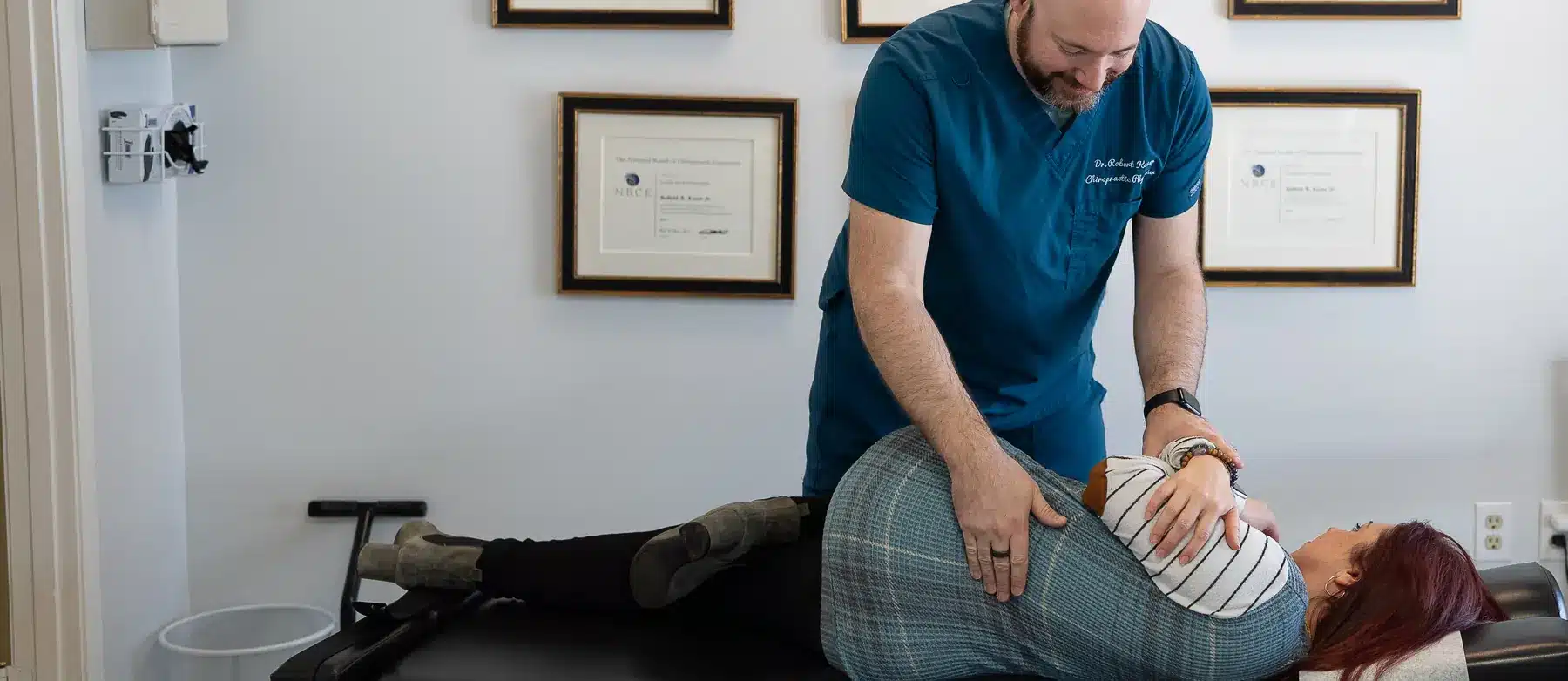
Telling them apart is what an examination is for. You see Dr. Bobby Koser, DC, chiropractic physician, at every visit, and you get your findings the same day, in language you can repeat to someone at home.
Low Back Pain Overview
What actually causes most low back pain
The low back is the five segments between your ribs and your pelvis, plus the joints where the spine meets the pelvis. Most people call it the lower back. What they describe: a deep ache after a day on their feet, a catch bending to load the dishwasher, a back that is locked up for the first hour of the morning and loosens as they move, or pain that runs into the buttock and down a leg. Those are separate problems with separate exams behind them.
What people usually notice:
- Worse getting out of a chair
- Worse standing or walking
- Better standing, worse sitting
- Catches when you bend
- Stiff for the first hour of the day
- Aches into the buttock or hip
- Travels down one leg
- Started in a car accident
In a large share of low back pain, nobody can name the exact structure with certainty. The clinical term is nonspecific low back pain, and it is not a dodge. It is an accurate description of a region where several tissues share the load and any of them can be the sore one.
What an examination does is narrow it, not to a millimeter but to a pattern, which is what tells us what to treat and what to leave alone.
- The joints at the back of the spine. Often worse standing, walking, or leaning back, and easier sitting or bending forward. Usually one-sided and close to the midline.
- The disc. Often worse sitting, bending forward, and climbing out of a car, and easier standing or walking. This is the pattern most likely to send symptoms into a leg, which is what most people mean when they say sciatica.
- The sacroiliac joint, where the spine meets the pelvis. One-sided, low, near the dimple above the buttock, and frequently worse rolling over in bed or standing up out of a low chair.
- Muscle. Trigger points in the gluteus medius (the muscle at the side of the hip), the quadratus lumborum (the deep muscle between the ribs and the pelvis), and the low back extensors refer pain into the buttock and hip convincingly enough that people arrive certain they have a disc problem.
- A nerve root. Leg symptoms below the knee, sometimes with numbness or weakness. These are the ones we test reflexes and strength for.
- Something that is not the back at all. Hips refer into the low back. So, occasionally, does a problem that has nothing to do with the spine. That is part of why the history takes a while.
Most people arrive with a mix. A disc pattern with angry muscles stacked on top of it is more common than either one on its own, which is why the plan usually has to address both.
One more pattern worth naming: lower back pain on one side. Pain that stays on the left side or the right most often points at the joints at the back of the spine, the sacroiliac joint, or a muscle on that side. The side is a clue, not a diagnosis.
A pinched nerve in your lower back
"Pinched nerve" gets used for a lot of different things: a stiff joint, a muscle in spasm, a trigger point referring pain, and sometimes an actual compressed nerve. The strict meaning is a nerve that is compressed or irritated. In the lower back that usually means a nerve root, pressed on by a disc, by a narrowed opening where the nerve leaves the spine, or by swollen tissue nearby. Here is the part that surprises people. The back itself may barely hurt. The classic story is pain running down one leg, sometimes with numbness, tingling, or weakness, and that leg pattern is what most people mean by sciatica. The neurological screen is how we test for it: reflexes, strength, sensation, and the leg-raising tests. Those results tell us what the nerve is doing and whether care here makes sense. If the findings call for a different kind of workup, we say so and refer you.
Related reading: Back injuries and who patients see first, on what the research says about the first provider a back-injured worker sees.
Pain higher up the back is a different examination. Mid-back and upper-back complaints are on our spine care page, and the neck has its own page: neck pain in Tampa and Carrollwood.
What the Pain Source Exam looks for in a low back
The Pain Source Exam is the new-patient visit. Applied to a low back, here is what it can work through.
Not every low back needs every one of these. What gets tested depends on what your history points at.
- Your history, in detail. When it started and what you were doing. What makes it worse in the next ten minutes, and what makes it worse by tomorrow morning. Sitting versus standing. Whether it travels, and how far down the leg it goes.
- How your back moves. Bending, leaning back, side bending, and what repeated movement does to your symptoms. When leg pain pulls back toward the spine as you move in one particular direction, that is useful, and it shapes the plan.
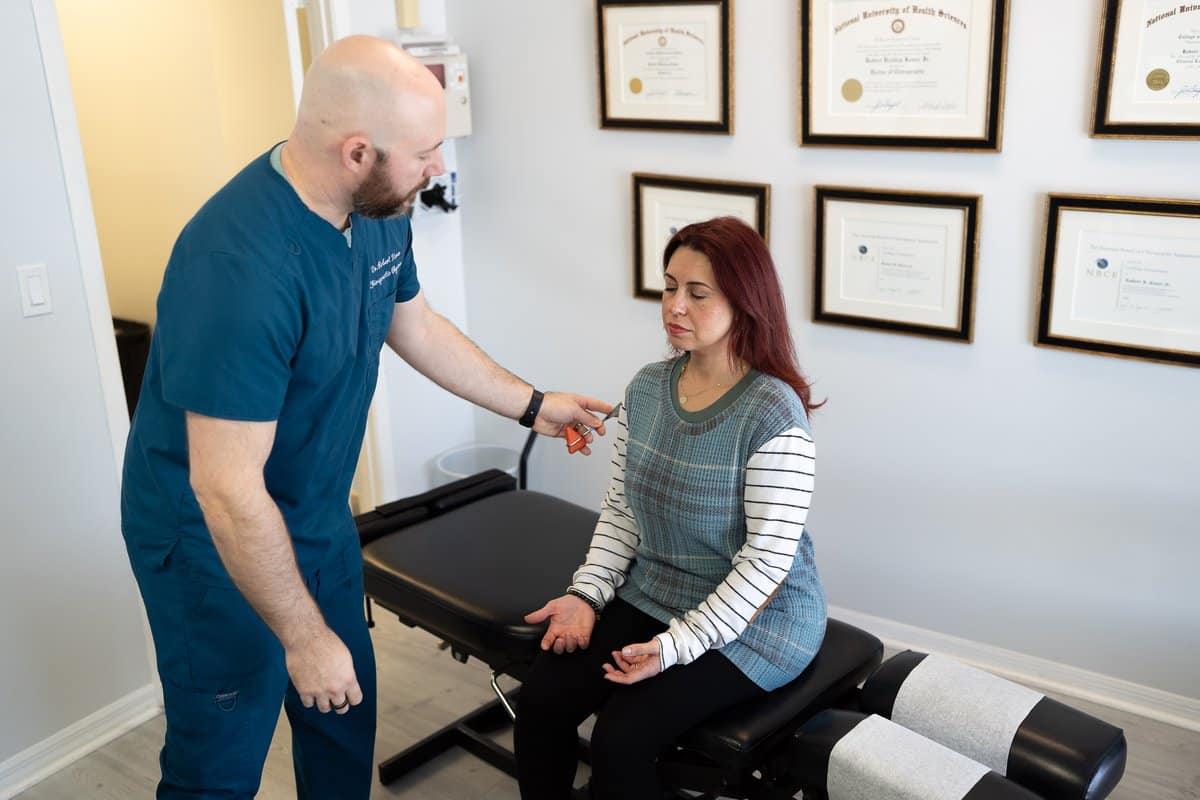
- Hands-on segmental testing. Which segments move, which are stuck, and where the tenderness maps. Dr. Koser tests the gluteus medius, the quadratus lumborum, and the low back extensors by hand, because muscle referral imitates disc pain closely enough to fool both of us if nobody checks.
- The hip and the sacroiliac joint. Both refer into the low back. Hip problems get treated as back problems for months when nobody puts the hip through its range.
- A neurological screen when symptoms travel. Reflexes, strength, sensation, and the leg-raising tests. This is the part that tells us whether a nerve root is involved, and whether anything here needs a different kind of workup.
- A live ultrasound look. Dr. Koser places the probe on the muscles and soft tissue where it hurts, and you watch the screen with him. Be clear about what this is and is not. It looks at muscle and soft tissue. It does not see a disc, and it does not look inside the spinal canal. It is screening and visual confirmation during your visit, not a replacement for an MRI when one is needed.
- Your findings, the same day. What was found, what it means, and what he suggests next.
What treatment looks like here
Treatment follows the exam. Below are the services that may be recommended to you. Your plan is whichever of them your findings actually call for.
| Option | What it is for |
|---|---|
| Chiropractic adjustment | Segments and the sacroiliac joint when the exam finds them restricted. For a lumbar spine that is usually prone or side posture, depending on the segment and on you. |
| Dry needling | Trigger points and myofascial pain in the gluteus medius, the quadratus lumborum, and the low back extensors. Thin needles into the muscle, nothing on them or in them. Dr. Koser is certified in dry needling by the Florida Department of Health. |
| Ultrasound-guided dry needling | Same treatment, performed with live ultrasound so the needle can be seen reaching the spot being treated. You watch it on the screen. It is a way of performing the procedure more precisely, not a different treatment. Seeing the needle does not change what the needling does. More on how dry needling works here. |
| Loading and movement guidance | The directions to add and the ones to back off, based on how your back responded to repeated movement during the exam. |
| Therapies and modalities | Traction, e-stim, laser, cupping and hands-on soft-tissue work are offered at your visit rather than booked online. They are priced separately from the visit and quoted before they are used. |
Sessions and therapies are performed by Dr. Koser, or by clinical staff working under his direct supervision at the same visit. Therapies and modalities are quoted at your visit and are not included in the visit prices below.

An adjustment and dry needling both work on the tissue being treated that day. Neither one changes how you sit, lift, and move for the rest of the week, which is why what we ask you to do between visits is part of your plan.
We re-measure as we go, so you can see what changed instead of taking our word for it. The goal is for you to need as few visits as possible.
What the Research Shows
Every treatment listed above has been studied. Here is what the research actually found, cited in full so you can check it yourself.
On chiropractic care. In its 2017 guideline, the American College of Physicians advised starting with non-drug care for most low back pain, and its recommended options for both new and long-lasting episodes include spinal manipulation, the treatment at the core of chiropractic care.1 A 2019 review in the BMJ pooled 47 clinical trials and found spinal manipulation works about as well as other recommended treatments for chronic low back pain, with side effects the review described as mostly brief and self-limited to the visit period.2 That is the honest shape of it: a recommended option among recommended options. We treat it that way.
On acupuncture. The same ACP guideline lists acupuncture among its recommended first-line options, with moderate-quality evidence behind it for chronic low back pain.1 An analysis of individual patient data from 39 trials and more than 20,000 patients found acupuncture outperformed both sham needling and no-acupuncture care for chronic musculoskeletal pain, and that most of the benefit was still present a year later.3 Dr. Koser is certified in acupuncture by the Florida Board of Chiropractic Medicine.
On dry needling. A 2018 review of 11 clinical trials found dry needling of myofascial trigger points reduced low back pain right after treatment, and worked better when combined with other care such as exercise.4 That is how it is used here: as one part of a plan.
On movement. A 2021 Cochrane review of 249 trials concluded that exercise therapy probably reduces chronic low back pain more than no treatment or usual care.5 The improvement in day-to-day function was smaller than the pain benefit, which is worth knowing. It is also why the loading guidance in your plan comes from your exam rather than from a printout of generic stretches.
None of this is a promise about your back. It is the reason these treatments are offered here.
1. Qaseem A, Wilt TJ, McLean RM, Forciea MA; Clinical Guidelines Committee of the American College of Physicians. Noninvasive treatments for acute, subacute, and chronic low back pain: a clinical practice guideline from the American College of Physicians. Ann Intern Med. 2017;166(7):514–530. PubMed
2. Rubinstein SM, de Zoete A, van Middelkoop M, Assendelft WJJ, de Boer MR, van Tulder MW. Benefits and harms of spinal manipulative therapy for the treatment of chronic low back pain: systematic review and meta-analysis of randomised controlled trials. BMJ. 2019;364:l689. PubMed
3. Vickers AJ, Vertosick EA, Lewith G, et al; Acupuncture Trialists’ Collaboration. Acupuncture for chronic pain: update of an individual patient data meta-analysis. J Pain. 2018;19(5):455–474. PubMed
4. Liu L, Huang QM, Liu QG, et al. Evidence for dry needling in the management of myofascial trigger points associated with low back pain: a systematic review and meta-analysis. Arch Phys Med Rehabil. 2018;99(1):144–152.e2. PubMed
5. Hayden JA, Ellis J, Ogilvie R, Malmivaara A, van Tulder MW. Exercise therapy for chronic low back pain. Cochrane Database Syst Rev. 2021;9(9):CD009790. PubMed
When imaging matters for low back pain, and when it doesn’t
A lot of money and a lot of worry get spent here, so it is worth being direct.
For a new episode of low back pain with a normal neurological exam and nothing concerning in the history, current clinical guidance is not to image. The American College of Physicians reached that conclusion in its High Value Care advice on diagnostic imaging for low back pain, and the family medicine Choosing Wisely list and radiology's own appropriateness guidance say the same thing. Routine X-ray, CT or MRI in the first several weeks does not improve how people do. It carries cost, radiation in two of the three, and a real chance of turning up something that sends everyone off in an unhelpful direction.
6. Chou R, Qaseem A, Owens DK, Shekelle P. Diagnostic imaging for low back pain: advice for high-value health care from the American College of Physicians. Ann Intern Med. 2011;154(3):181–189. PubMed
| What we’re looking at | What it shows well | What it cannot do |
|---|---|---|
| X-ray | Bone. Alignment, fracture, arthritic change, and the shape of the spine under load. | It does not show discs, nerves, or muscle. Arthritic change on an X-ray is extremely common with age and does not by itself establish where your pain comes from. |
| MRI | Discs, nerve roots, the spinal canal, bone marrow, and soft tissue. It is the study when a nerve root problem is not settling, or when something in the exam points past mechanical pain. | It does not tell you which finding hurts. An MRI report has to be read next to an examination or it is just a list. |
| Ultrasound, in this office | Muscle and soft tissue, live, while you watch. Used for screening and for visual confirmation while treating. | It cannot see a disc, a nerve root, or inside the spinal canal, and it does not take the place of an X-ray or MRI when one is needed. |
Scans find things in backs that do not hurt
A 2015 systematic review in the American Journal of Neuroradiology pooled imaging studies of people with no back pain at all. Disc degeneration showed up in 37% of pain-free 20-year-olds and 96% of pain-free 80-year-olds. Disc bulges: 30% at 20, 84% at 80.7
Two things follow, and the second one gets left out more often than the first. A finding on a report is not automatically the cause of your pain, so a frightening radiology sentence deserves to be read beside an examination before anyone acts on it. And the reverse holds as well: a finding can be entirely real and entirely relevant. When the picture and the exam agree, the picture earns its place. This is a review of pain-free volunteers. It is not a prediction about you, and nothing in it is a promise about how you will respond to care.
7. Brinjikji W, Luetmer PH, Comstock B, et al. Systematic literature review of imaging features of spinal degeneration in asymptomatic populations. AJNR Am J Neuroradiol. 2015;36(4):811–816. PubMed
How long a new episode usually takes
Studies that follow people through a new episode of low back pain generally find quick improvement over the first six weeks, then a much slower curve, with a meaningful number of people still reporting some pain at a year and recurrence inside twelve months being common.8 Those are population averages and they may not resemble your case. We would rather hand you that than promise you six visits.
8. Menezes Costa L, Maher CG, Hancock MJ, et al. The prognosis of acute and persistent low-back pain: a meta-analysis. CMAJ. 2012;184(11):E613–E624. PubMed
When imaging does earn its place
After a significant injury, including a car accident. When the neurological exam is abnormal or getting worse. When symptoms are not behaving mechanically. And when the result would actually change the decision in front of us, such as a referral for a surgical or interventional opinion. If your exam points that way, Dr. Koser refers you and tells you what he is looking for.
Already had back surgery, and the pain came back or never left? That situation has its own page: pain after back surgery.
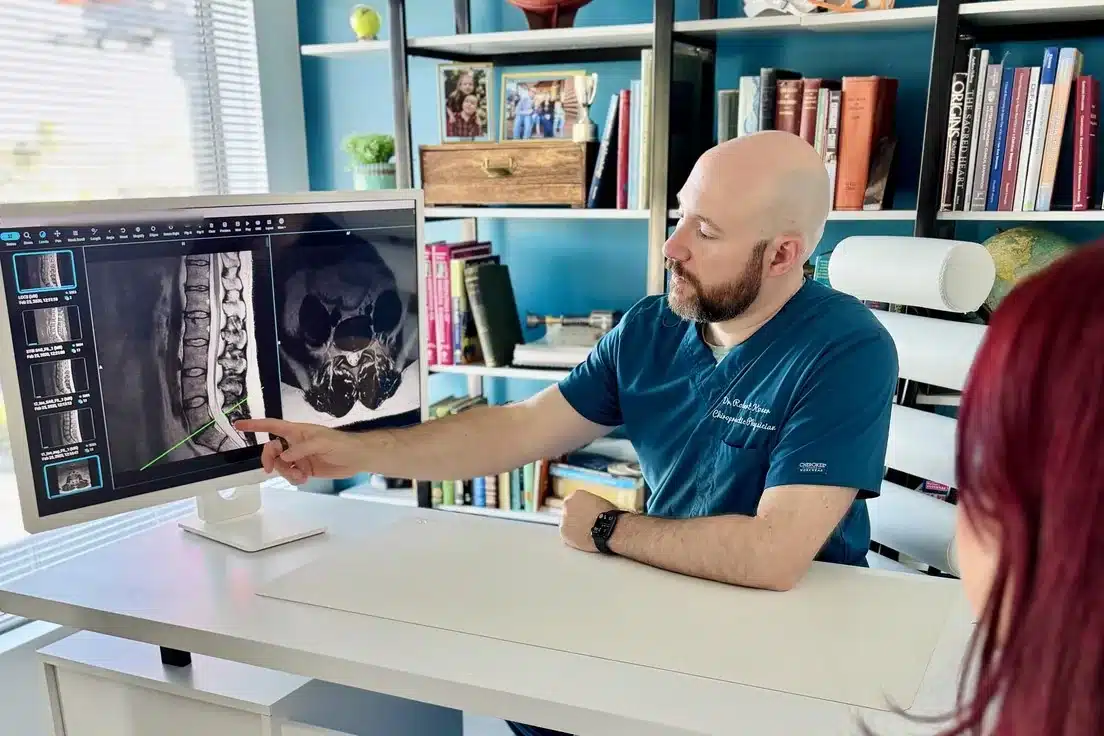
If you already have an MRI, X-ray, or CT, bring the report and the disc to your visit. Dr. Koser completed post-doctoral training in spinal MRI interpretation and clinical correlation, and reading your imaging with you is part of the examination. If you have been given a recommendation and want a second read of what the images actually show, that is a reasonable reason to book.
The exam’s first job: making sure this back pain is ours to treat
Most low back pain is mechanical. A small share is not. Part of what the history and the neurological screen are for is sorting that out on day one rather than six visits in.
Go to an emergency room, not to us, if back pain arrives with trouble passing urine, difficulty telling when your bladder is full, loss of bladder or bowel control, numbness in the saddle area between your legs, new pain or numbness down both legs, or leg weakness that is getting worse quickly. That combination is uncommon, and it is time-sensitive.
Back pain with fever, pain that does not change no matter what position you are in, a history of cancer, or an injury in someone whose bones are already fragile also belongs in a medical workup first. If your exam points that direction, we will tell you and help you get to the right provider instead of treating around it.
If the emergency list above describes you, go to the emergency room rather than booking. For the rest, get a medical workup first. Otherwise, book the exam and we’ll sort it in the room.
This page is general information about a common condition. It is not advice about your particular back, and reading it is not a substitute for being examined.
If your low back pain started in a car accident
Different visit, different paperwork, different lane. Florida’s PIP law makes your no-fault medical benefits available only if your initial care is received within 14 days of the accident. Accident care is billed to your auto insurance under Florida PIP rather than charged to you at our self-pay rates. Book the Auto Accident Injury Visit rather than the Pain Source Exam.
PIP has its own math: it pays 80 percent of covered charges, and what is available for your care depends on your policy and on an emergency medical condition determination. The full breakdown, statute linked, is on our Florida PIP page, and we verify your coverage before you start.
You do not need to be in pain today for it to be worth getting examined inside that window. Symptoms after a collision often begin in the days that follow rather than at the scene, once the initial surge of a crash settles. Getting examined inside the 14 days means whatever we find is documented while the window is still open.
If you have an attorney, tell us and we send documentation to their office on their timeline. If you do not have one, we open your PIP paperwork and treat you the same way. A lawyer is not a requirement to be seen here for care. How car accident care works here, or read the statute in plain English on our Florida PIP page.
What it costs to start
$195Regular price $330
Self-pay only, one per patient.
Pain has a source. This visit looks for where it is coming from.
- A complete examination with Dr. Koser, which may include a live ultrasound look at the muscles and soft tissue where it hurts.
- Treatment the same visit unless the examination finds a reason it should not: a chiropractic adjustment, dry needling, cupping, laser, or electrical stimulation with infrared, chosen from what the examination finds and what is safe for you.
- Your findings explained the same day.
You’ll leave knowing what we found and what it means. First visit with us, one per patient.
Not ready to begin a membership? Start here and pay as you go. Membership rates apply only under a signed membership agreement. See membership plans.
Self-pay patients only. Not valid with insurance, PIP/auto claims, Medicare, or Medicaid. Injured in a car accident? Book the Auto Accident Injury Visit instead.
THE PATIENT AND ANY OTHER PERSON RESPONSIBLE FOR PAYMENT HAS A RIGHT TO REFUSE TO PAY, CANCEL PAYMENT, OR BE REIMBURSED FOR PAYMENT FOR ANY OTHER SERVICE, EXAMINATION, OR TREATMENT THAT IS PERFORMED AS A RESULT OF AND WITHIN 72 HOURS OF RESPONDING TO THE ADVERTISEMENT FOR THE FREE, DISCOUNTED FEE, OR REDUCED FEE SERVICE, EXAMINATION, OR TREATMENT.
Every other bookable price is on our pricing page.
Common questions about low back pain
What causes most low back pain?
Most low back pain is mechanical: it comes from the spinal joints, the disc, the sacroiliac joint, or the low back muscles, and how they are loaded. Often no single structure can be named with certainty; clinicians call that nonspecific low back pain. Joints tend to hurt standing and leaning back, discs sitting and bending forward, and trigger points in the buttock and low back muscles can imitate a disc.
Do I need an MRI for low back pain?
Usually not at first. For a new episode with a normal neurological exam and no concerning history, guidance is against routine imaging in the first several weeks: it does not change how people do, and scans show changes common in pain-free people. Imaging earns its place after significant injury, an abnormal or worsening exam, symptoms not behaving mechanically, or a result that would change the decision; Dr. Koser refers you.
Can a chiropractor help low back pain?
Low back pain is squarely within what a chiropractic physician examines and treats. Dr. Bobby Koser, DC, examines your low back, hip and sacroiliac joint, tests reflexes and strength when symptoms travel into a leg, and then treats what the exam found: a chiropractic adjustment for segments that are restricted, dry needling for trigger points and myofascial pain, and loading guidance for what you do between visits. No referral is needed to book.
Is my low back pain coming from a disc or a muscle?
Either can be the source, and an examination tells them apart. Trigger points in the gluteus medius and quadratus lumborum refer pain into the buttock and hip and can pass for a disc. Disc pain more often worsens sitting, bending forward, and climbing out of a car, and is likeliest to travel below the knee. The Pain Source Exam tests both and tells you which one the findings point to.
How long does low back pain last?
Research that follows people through a new episode generally finds quick improvement over the first six weeks, then a much slower curve, with a meaningful number still reporting some pain a year later and recurrence within twelve months being common. Those are population averages and they may not resemble your case. We can’t give you a visit count before we examine you. What you get at HealthSpine in Carrollwood is what your examination actually found, an honest estimate based on it, and re-measurement as you go.
When should I see a medical doctor instead of a chiropractor for back pain?
Most back pain is not an emergency. Go to an emergency room for trouble passing urine, difficulty telling when your bladder is full, loss of bladder or bowel control, numbness in the saddle area between your legs, new pain or numbness down both legs, or leg weakness worsening quickly; that combination is uncommon and time-sensitive. Fever, pain that does not change in any position, a cancer history, or an injury with fragile bones calls for a medical workup first. Your first visit screens for these.
How do I know if my back pain is a kidney problem?
Kidney pain usually sits higher than most back pain, under the ribs on one side, and it often comes with fever or changes in urination. Musculoskeletal back pain typically changes with movement and position: certain motions make it better or worse. Kidney pain tends not to care what position you are in. An examination helps sort the two apart, and if what we find does not look musculoskeletal, we say so and point you to a physician.
My low back started hurting after a car accident. What is different?
A crash means a different visit and billing lane. Book the Auto Accident Injury Visit; it is billed to your auto insurance under Florida PIP, and the law requires initial care within 14 days of the accident. PIP pays 80 percent of covered charges after any deductible. $2,500 is available unless a qualifying provider determines you had an emergency medical condition, which can raise it to the $10,000 policy limit.
How much does treatment for low back pain cost in Tampa?
At HealthSpine in Carrollwood, new patients start with the Pain Source Exam at $195, an introductory price (regular price $330), self-pay only and one per patient. After that a chiropractic adjustment is $60, a dry needling session is $80. Our other prices are time-of-service rates, available when you pay in full at the visit. Care billed to a third-party payor, including auto insurance under Florida PIP, health insurance, Medicare, or workers' compensation, is billed on our standard fee schedule without either discount.
 Top 3 Finalist: Best Chiropractor
Creative Loafing Best of the Bay 2025 · Readers Pick
Quoted in National Press
See the coverage →
This page is general health information and is not medical advice for any individual. The studies summarized describe groups, not any one person’s outcome, and whether a finding explains your symptoms can only be determined by examination. Talk to Dr. Bobby Koser, DC, about your own situation, and seek emergency care immediately for the warning signs described on this page.
Find out what your low back is actually doing.
A complete examination with Dr. Koser, which may include a live ultrasound look, and your findings the same day. Book online, or call and we’ll talk it through first.
Book Onlineor call 844-51-SPINE (844-517-7463)