
Conditions · Carrollwood · Tampa Bay
Sciatica in Tampa
Sciatic nerve pain tells you where the problem travels. It does not tell you what is causing it, and that is the part that decides your treatment.
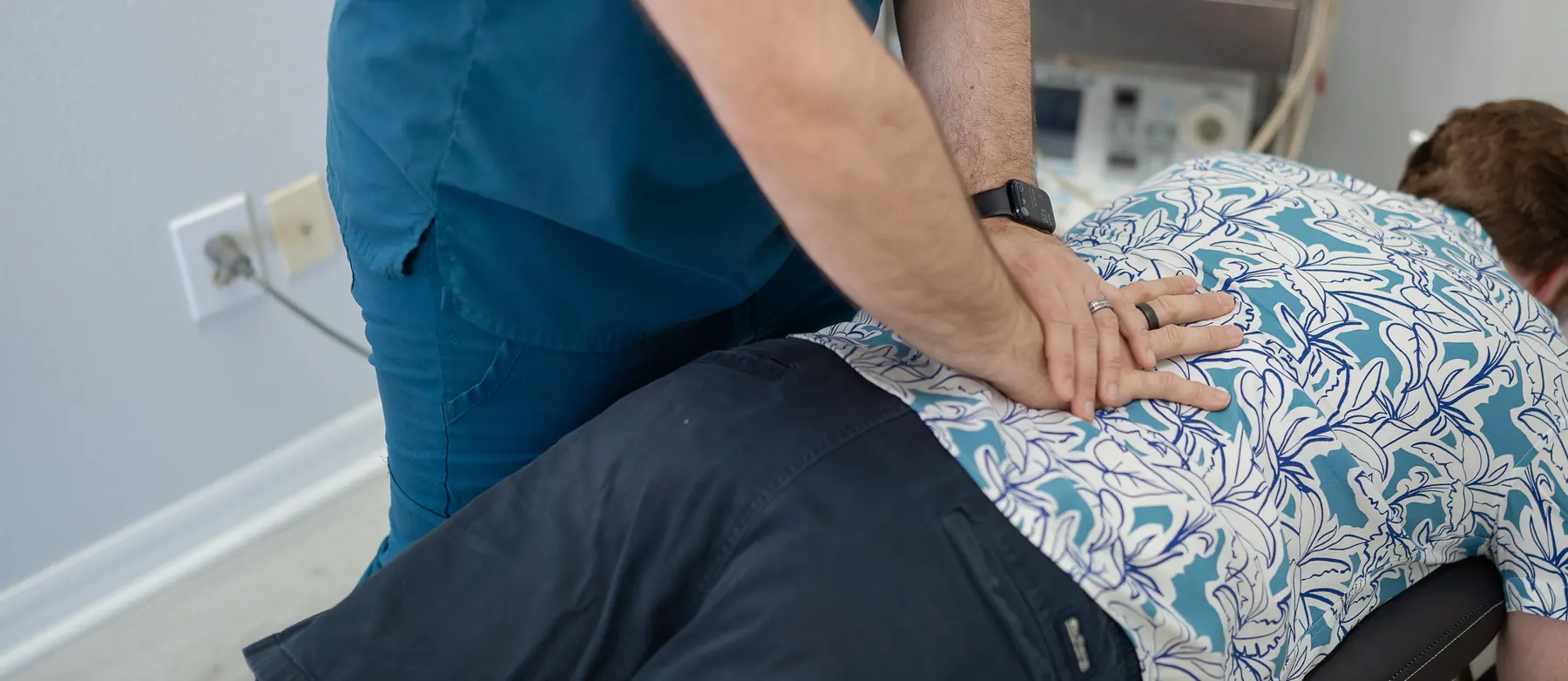
Pain that runs from the low back or buttock down into the leg has several possible sources. They do not respond to the same care. Dr. Bobby Koser, DC, chiropractic physician, examines you, works out which source fits your findings, and goes through it with you the same day. If what he finds belongs with a medical provider instead, he will say so.
Sciatica Overview
What sciatica actually is
Sciatica names a pattern, not its cause.
The word describes a pattern: pain, tingling, burning, or numbness that starts in the low back or the buttock and travels down the back or the side of the leg, sometimes past the knee and into the foot, and usually in one leg. It can be a heavy ache, or it can be electric and sudden.
What the word does not tell you is which structure is irritating the nerve, or whether a nerve is involved at all. That is the question worth answering, because the answer changes what should be done about it. Two people can describe their leg pain in nearly the same sentence and need two different plans.
Sciatica is what your pain is doing. The examination is about what is making it do that.
Is sciatica a pinched nerve?
Often, yes. But "pinched nerve" is a phrase people use for a lot of different problems, and they are not treated the same way. In the strict sense it means a nerve root compressed or irritated where it leaves the spine, usually by a disc, a narrowed opening, or swollen tissue nearby. Those roots feed into the sciatic nerve, so the pain shows up down the leg instead of where the problem sits. That mismatch confuses a lot of people: the leg hurts, but the cause is in the back.
But not all sciatica pain is a pinched nerve. Trigger points in the gluteal muscles and irritation of the nerve in the buttock can copy the pattern closely without touching a nerve root. The examination is how you tell a pinched nerve from an imitation, and they are not treated the same way.
Where sciatic nerve pain comes from
These are the common ones. Each behaves a little differently, and how yours behaves is evidence.
| Source | What it usually looks like |
|---|---|
| A lumbar disc irritating a nerve root | Often worse sitting, bending forward, or with a cough or a sneeze. One leg, and it can travel below the knee. This is the picture most people have in mind when they say the word. |
| Narrowing around the nerve root | More common later in life. Heaviness and pain build as you stand and walk, then ease when you sit or lean forward on a cart. Both legs, sometimes. |
| Trigger points in the buttock and low back muscles | Muscles in the gluteal group and alongside the spine refer pain down the leg in a pattern that reads as sciatica. Pressing the right spot reproduces your exact symptoms. No nerve root is being compressed. It is easy to overlook, because the pattern looks like a nerve. |
| Irritation of the nerve in the buttock rather than the spine | Worse after long stretches of sitting or driving, with tenderness deep in the buttock instead of the back. |
| The sacroiliac joint or a lumbar facet joint | Refers into the buttock and the back of the thigh, and usually stops above the knee. Reflexes and strength test normal. |
More than one of these can be true at the same time. That is common, and it is the reason the plan gets built from an examination instead of from the word. Sciatica sits inside the wider picture covered on our spine care page.
Not everything that hurts down the leg is sciatica
Three patterns get called sciatica regularly and are something else.
- The hip joint. Pain in the groin or the front of the thigh, sometimes down as far as the knee, worse turning the leg in, and awkward putting on a sock or a shoe. The hip refers pain into places people expect the back to cause.
- Circulation. Cramping in the calf that comes on after walking a fairly predictable distance and settles when you stand still. That pattern is vascular. It belongs with a physician.
- The hamstring tendon at the sitting bone. Right at the bone, worse on hard chairs, and it usually stays above the knee.
Telling these apart is an examination question. It is why the hip, the calf, and the sitting bone are worth checking before anyone settles on the word sciatica.
Can a chiropractor help with sciatica?
Yes in many cases, and no for others. An examination, and imaging when the examination calls for it, is what tells you which one you have.
The split works like this. Restricted spinal and sacroiliac joints, trigger points in the buttock and low back that refer pain down the leg, and the movements and positions that keep provoking your symptoms are all things a chiropractic physician examines and treats directly. Where a disc is irritating a nerve root, part of what surrounds it is still mechanical. Whether that is what you have, and whether the mechanical part is worth treating in your case, is what the examination decides.
What chiropractic care does not do is remove a disc fragment or permanently open a narrowed spinal canal, for example. That does not mean there is nothing to treat. The joints, the muscles, and the movements around those findings are still examined and still treated. If what you have belongs with a medical provider, we’ll tell you and help you get to the right provider.
What the exam checks
- Where the pain actually goes. He draws it. The label you arrived with is a starting point. Pain that stops above the knee and pain that runs into the calf or foot point in different directions.
- What makes it worse and what makes it better. Sitting, standing, walking, bending, coughing, getting out of the car. This history is one of the most useful things in the whole exam, and it is the part patients tend to underestimate.
- Nerve tension testing. Raising the straight leg, or the slump test, puts tension along the nerve. If that reproduces your leg pain rather than a stretch, it points toward the nerve root.
- Reflexes, strength, and sensation. The knee and ankle reflexes, big-toe strength, heel and toe walking, and where sensation has changed. These map onto specific nerve levels in the lower spine, which is how a symptom in your foot gets tied to a level in your back.
- Hands on the muscles. He presses the gluteal muscles and the muscles alongside the spine to see whether a trigger point reproduces your leg pain. When it does, that is a finding.
- Hip and sacroiliac testing. To rule the hip in or out before anything gets treated.
- A live ultrasound look. On a Pain Source Exam there may be a live ultrasound look at the muscles and soft tissue where it hurts. One honest limit: ultrasound does not see into the spinal canal. It looks at muscle and soft tissue, not at discs or nerve roots.
- Findings the same day. You hear what he found and what it means at that visit. If something has to wait on imaging or on another provider before he can be sure, he tells you that at the visit too.
Do you need an MRI?
Sometimes, though not usually at the start of an episode.
An MRI shows discs and nerve roots, which an examination can only infer. The catch is that these findings appear on the scans of people with symptoms and people without them. A 2015 systematic review pooled imaging studies of people with no back pain at all. Disc bulges appeared in about 30% of pain-free 20-year-olds and about 84% of pain-free 80-year-olds.1
That cuts both ways: a finding on your report is not automatically the cause of your leg pain, and your pain is not less real because the same words appear on other people’s reports. Connecting the two is the examination’s job.
So a bulge on a report does not establish that the disc is your problem, and a clean scan does not mean nothing hurts. The scan is one input. What makes it useful is matching it against an examination: the level the imaging flags should be the level your exam findings already pointed to.
Imaging earns its place when the examination calls for it. Weakness that is progressing, symptoms that are not improving the way they should, a history that changes the picture, or a traumatic injury such as a car accident are the usual reasons.
If you already have an MRI, X-ray, or CT, bring the report and the disc to your visit. Dr. Koser completed post-doctoral training in spinal MRI interpretation and clinical correlation, and reading your imaging with you is part of the examination. If you have been given a recommendation and want a second read of what the images actually show, that is a reasonable reason to book.
1. Brinjikji W, Luetmer PH, Comstock B, et al. Systematic literature review of imaging features of spinal degeneration in asymptomatic populations. AJNR Am J Neuroradiol. 2015;36(4):811–816. These are pooled figures from pain-free volunteers. They are not a prediction about your scan or your case. PubMed
How sciatica gets treated here
What you are offered depends on what the examination found. These are the services that may be recommended to you, not a fixed plan for everyone.
| Option | What it addresses |
|---|---|
| Chiropractic adjustment | Spinal segments and the sacroiliac joint that are not moving the way they should, when your examination points there. |
| Flexion-distraction | A table-based technique for the low back. The lower section of the table moves to slowly flex and lengthen the segment while Dr. Koser keeps contact on it. There is no thrust involved, which is part of why it is an option when a thrust technique is not the right choice for you. |
| Dry needling | Trigger points and myofascial pain in the gluteal muscles, the deep hip rotators, and the muscles alongside the spine, which refer pain into the leg. Dr. Koser is certified in dry needling and can perform it with ultrasound guidance when a muscle sits deeper than feel can confirm. More on how dry needling works here. |
| Loading and movement work at home | The positions and directions that settle your symptoms, the ones to stay off for now, and the progression between them. This part depends on you. |
| Sitting, driving, and lifting guidance | How long you sit before you get up, how your seat is set, and what to change about lifting while the nerve is sensitive. |
| Referral, when that is the answer | Not a treatment. It is on this list because some cases belong with a medical provider, and finding that out early is worth more than any of the rows above it. |
We examine before we treat. Where the exam points at a muscle, we treat the muscle. Where it points at a joint that is not moving, we treat the joint. Where it points somewhere neither of those reaches, we say that out loud.

Is your sciatica a chiropractic case? The exam answers that on day one.
Most sciatica is mechanical, though a small number of cases need a medical workup instead, and a few need one the same day.
- Leg weakness that is getting worse. A foot that catches on a stair, or a knee that gives way.
- Trouble passing urine, difficulty telling when your bladder is full, loss of bladder or bowel control, or numbness through the saddle area. That one is an emergency room visit.
- New pain or numbness down both legs, rather than down one. That one is an emergency room visit too.
- Sciatica arriving with a fever, following a significant fall or crash, or alongside a medical history that changes the picture.
If anything in your history or your exam points that way, we’ll tell you and help you get to the right provider. That check happens at the first visit, before any treatment starts, and if your exam points to a physician you’ll hear it in the room.
If either of the emergency-room items describes you, go to the emergency room rather than booking. For the others, get medical care first. Otherwise, book the exam and we’ll sort it in the room.
What the Research Shows
We would rather tell you this ourselves than have you find it later.
On time
Nobody can tell you how long yours will take before examining you, and a number offered over the phone is a guess. What you get here is an estimate built on your findings and re-measured as you go. Leg pain running longer than Dr. Koser told you to expect is a reason to come back and be looked at again, not a reason to keep going.
On chiropractic care
Manual care acts on the mechanical part of the problem: the joint that has stopped moving, the muscle that is loaded and referring. Where a nerve root is under pressure from a disc, that is not what an adjustment reaches. Treating what is mechanical can still be worth doing. Repeating a plan that is not changing anything is not, and that is the honest limit on it.
On acupuncture
In a 2024 randomized trial in JAMA Internal Medicine, adults with chronic sciatica from a herniated disk received ten acupuncture sessions over four weeks. They reported less leg pain and better function than those who received sham acupuncture, and the difference was still present a year later.2 That is one well-run trial rather than a settled literature, and it studied disk-related sciatica specifically. Dr. Koser is certified in acupuncture by the Florida Board of Chiropractic Medicine.
On dry needling
Needling treats muscle, so where a gluteal or low back trigger point reproduces your leg symptoms on examination, that muscle is a target we can treat. Where the source is a nerve root under pressure from a disc, needling the muscle is not addressing it, and saying so is more useful to you than needling it anyway.
On staying active
A 2015 review found that guided exercise gave slightly more short-term leg pain relief than advice to stay active alone, and that both approaches did about equally well over the long run.3 The useful part is what both arms of that research had in common: movement, dosed sensibly, is part of the treatment rather than a threat to it.
Nothing on this page is a prediction about your case. What you get here is what your examination found and what Dr. Koser thinks it means.
2. Tu JF, Shi GX, Yan SY, et al. Acupuncture vs sham acupuncture for chronic sciatica from herniated disk: a randomized clinical trial. JAMA Intern Med. 2024;184(12):1417–1424. PubMed
3. Fernandez M, Hartvigsen J, Ferreira ML, et al. Advice to stay active or structured exercise in the management of sciatica: a systematic review and meta-analysis. Spine (Phila Pa 1976). 2015;40(18):1457–1466. PubMed
If your sciatica started with a car accident
Symptoms after a collision often begin in the days that follow rather than at the scene, once the initial surge of a crash settles. That visit is a different visit from the one described above, with different paperwork and a different way of being billed.
Florida’s PIP law requires that your care begin within 14 days of the accident. Auto accident care is billed to your auto insurance under Florida PIP, on our standard fee schedule without the time-of-service discount. If you already have an attorney, tell us and we send documentation to their office on their timeline. If you do not have one, we still open your paperwork and treat you the same way.
See car accident chiropractic care in Tampa, or read the statute in plain English on our Florida PIP page.
What it costs to start
$195Regular price $330
Self-pay only, one per patient.
Pain has a source. This visit looks for where it is coming from.
- A complete examination with Dr. Koser, which may include a live ultrasound look at the muscles and soft tissue where it hurts.
- Treatment the same visit unless the examination finds a reason it should not: a chiropractic adjustment, dry needling, cupping, laser, or electrical stimulation with infrared, chosen from what the examination finds and what is safe for you.
- Your findings explained the same day.
You’ll leave knowing what we found and what it means. First visit with us, one per patient.
Not ready to begin a membership? Start here and pay as you go. Membership rates apply only under a signed membership agreement. See membership plans.
Self-pay patients only. Not valid with insurance, PIP/auto claims, Medicare, or Medicaid. Injured in a car accident? Book the Auto Accident Injury Visit instead.
THE PATIENT AND ANY OTHER PERSON RESPONSIBLE FOR PAYMENT HAS A RIGHT TO REFUSE TO PAY, CANCEL PAYMENT, OR BE REIMBURSED FOR PAYMENT FOR ANY OTHER SERVICE, EXAMINATION, OR TREATMENT THAT IS PERFORMED AS A RESULT OF AND WITHIN 72 HOURS OF RESPONDING TO THE ADVERTISEMENT FOR THE FREE, DISCOUNTED FEE, OR REDUCED FEE SERVICE, EXAMINATION, OR TREATMENT.
Every other bookable price is on our pricing page.
Common questions about sciatica
Can a chiropractor help with sciatica?
Often yes, though it depends on what is causing it: the word sciatica names a pain pattern rather than its source. Dr. Bobby Koser, DC, examines you first, then treats the mechanical sources: restricted spinal and sacroiliac joints, trigger points referring pain down the leg, and the loads provoking it. Chiropractic care does not remove a disc fragment or permanently open a narrowed spinal canal; those findings, and worsening leg weakness, belong with a medical provider.
What causes sciatica?
Sciatica describes where pain travels, so the cause is whatever is irritating the nerve or referring pain along that path. The common sources are a lumbar disc irritating a nerve root, narrowing around the nerve root, trigger points in the gluteal and low back muscles that refer pain down the leg, irritation of the nerve in the buttock rather than the spine, and referred pain from the sacroiliac or facet joints. More than one can be present at once. Which one you have is what the examination is for, because they are not treated the same way.
Is sciatica the same thing as low back pain?
No. Low back pain stays in the low back. Sciatica travels: pain, tingling, burning, or numbness that runs from the low back or buttock down the back or side of the leg, sometimes past the knee. Plenty of people have both at once, and which one is driving the other is worth sorting out, because leg symptoms and back symptoms do not always come from the same place.
Do I need an MRI for sciatica?
Not usually at the start. In a 2015 systematic review of pain-free volunteers, disc bulges appeared in about 30% of 20-year-olds and about 84% of 80-year-olds,1 so a bulge on a report does not by itself explain your leg pain. An MRI earns its place when the examination calls for it: progressing weakness, symptoms not improving as expected, or a history that changes the picture. Dr. Koser refers you then.
Does walking help sciatica?
It depends on the source, which makes it worth testing. Leg pain from a disc often eases with walking and worsens with long periods of sitting, so short and frequent walks can help. Leg pain from narrowing around the nerve root usually behaves the opposite way: it builds as you walk and settles when you sit or lean forward. Pain that climbs during a walk and stays up afterward is worth reporting. What your symptoms do while you move is examination information, so pay attention to it and tell Dr. Koser.
How long does sciatica last?
A timeline for your case is an examination question, and it is not one anybody can answer from a description over the phone. How long it takes depends on what is generating the leg pain, which is exactly what the examination is for. Dr. Koser gives you his estimate after he has examined you, and re-measures it as you go. Leg pain running longer than he told you to expect is a reason to come back and be re-examined rather than to keep going.
Does dry needling help sciatica?
It depends on what is generating the pain. Dry needling treats trigger points and myofascial pain, so where a gluteal or low back trigger point reproduces your leg symptoms on examination, that muscle is a target we can treat. Where a nerve root is under pressure from a disc, needling the muscle is not addressing the source, and Dr. Koser will tell you that rather than needle it anyway. Dry needling is one option matched to a finding, not a treatment for the word sciatica.
When should I see a doctor instead of a chiropractor for sciatica?
Most sciatica is mechanical and is treated conservatively. A short list of signs means medical care first: worsening leg weakness, a foot that catches on stairs, or sciatica that arrives with a fever or follows a significant fall. Any of these means an emergency room visit rather than an appointment: trouble passing urine, difficulty telling when your bladder is full, loss of bladder or bowel control, numbness through the saddle area, or new pain or numbness down both legs. Your first visit screens for all of these before any treatment starts.
How much does sciatica treatment cost in Tampa?
At HealthSpine in Carrollwood, new patients start with the Pain Source Exam at $195, an introductory price (regular price $330), self-pay only and one per patient. A chiropractic adjustment after that is $60, a dry needling session is $80. Membership plans are available, with member rates on the treatment visits above, under a signed membership agreement. Our other prices are time-of-service rates, available when you pay in full at the visit. Care billed to a third-party payor, including auto insurance under Florida PIP, health insurance, Medicare, or workers' compensation, is billed on our standard fee schedule without either discount.
 Top 3 Finalist: Best Chiropractor
Creative Loafing Best of the Bay 2025 · Readers Pick
Quoted in National Press
See the coverage →
Top 3 Finalist: Best Chiropractor
Creative Loafing Best of the Bay 2025 · Readers Pick
Quoted in National Press
See the coverage →
This page is general health information and is not medical advice for any individual. The studies summarized describe groups, not any one person’s outcome, and whether a finding explains your symptoms can only be determined by examination. Talk to Dr. Bobby Koser, DC, about your own situation, and seek emergency care immediately for the warning signs described on this page.
Find out what is actually causing your leg pain.
Book online, or call and we’ll talk it through first.
Book Onlineor call 844-51-SPINE (844-517-7463)