
Conditions · Carrollwood · Tampa Bay
Upper & Mid Back Pain
What thoracic pain, rib joint pain and the knot between your shoulder blades actually are, what a finding on your report does and does not tell you, and how a doctor trained in spinal MRI interpretation connects the picture to the person.
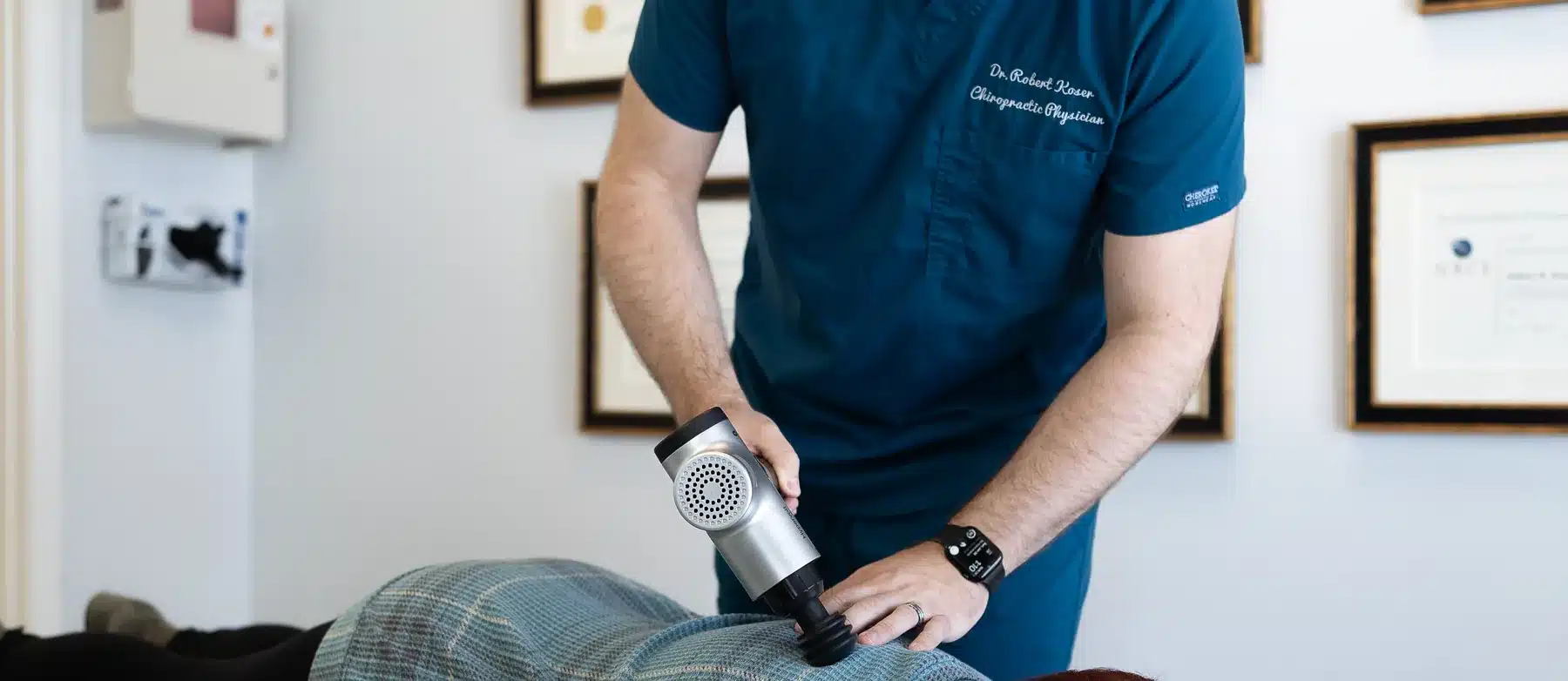
A radiology report is written for other doctors, not for you. So when yours says thoracic disc protrusion, end-plate irregularity, Scheuermann changes, or costovertebral degeneration, the words land without a translator, and at 11pm the internet fills the silence badly. This page is the translator. Dr. Bobby Koser, DC, chiropractic physician, completed post-doctoral training in spinal MRI interpretation and clinical correlation, and reviewing the report with the person it belongs to is part of the examination here. Bring yours.
Upper and Mid Back Pain Overview
What the words on your report mean
Your upper and mid back is the thoracic spine: twelve vertebrae running from the base of your neck down to the bottom of your ribcage. It is the one stretch of spine built into a cage. Every one of those twelve levels carries a pair of ribs, and each rib meets the spine at two separate joints, not one. Those joints move a little each time you take a breath, which is why pain in this region so often changes when you breathe in deeply. Most of the words a radiologist writes about this region describe one of four things: those rib joints, the discs between the vertebrae, the shape of the curve, or the muscles laid over the top of all of it.
Thoracic spine pain
The region name, not a diagnosis. Thoracic means the part of the spine your ribs attach to, so thoracic spine pain, thoracic pain, mid back pain and upper back pain all point at the same stretch of anatomy between the base of the neck and the bottom of the ribs. It tells you where the problem is being felt. It does not yet tell you which structure is producing it, and sorting that out is what an examination does.
Also written as: dorsal spine pain, interscapular pain (between the shoulder blades), thoracalgia. Reports sometimes name the level instead, as in T4 or T7, counting down from the top of the ribcage.
Rib joint pain: costovertebral and costotransverse
Each rib meets the spine at two joints. The costovertebral joint is where the head of the rib meets the side of the vertebral body, the block of bone at the front of the vertebra. The costotransverse joint is where the same rib meets the transverse process, the bony wing that projects sideways off the back of the vertebra. Costo means rib, so both words are simply naming the two ends of that connection. These joints sit a couple of inches out from the midline of your back, and they glide with every breath. When one of them is tender and moving less than the joints above and below it, people describe a catch with a deep breath, a cough, a sneeze, or turning to reach into the back seat.
Also called: rib pain, rib joint dysfunction, costotransverse or costovertebral joint pain, and in everyday speech “a rib out of place.” Ribs do not slip out of their sockets the way that phrase suggests. What the examination checks is how each of those joints is moving and whether it reproduces what you feel.
Trigger points and myofascial pain: the knot between the shoulder blades
A trigger point is a tender spot inside a taut band of muscle, the ropey strand you can feel under a thumb. Myofascial pain is the clinical name for pain coming from muscle and fascia, the sheet of connective tissue wrapped around and between muscles. The muscles that live between and under the shoulder blades are where most people meet both terms, because that is where the band of ache sits and where the knot is felt. One thing worth knowing before you go looking for the knot: the area between the shoulder blades is also a place where pain from the neck and from thoracic and rib joints is commonly felt, so the spot you point to and the structure producing it are not always the same address.
Also written as: myofascial trigger point, muscle knot, muscular strain, interscapular myofascial pain, rhomboid or trapezius pain, naming the muscles that sit there.
Thoracic disc bulge, protrusion, herniation, annular fissure
A spinal disc is a cushion between two vertebrae: a tough outer ring of fibers called the annulus, wrapped around a soft center called the nucleus. In the thoracic spine the same vocabulary applies as anywhere else in the spine. A bulge means the outer ring is intact and sags outward past its normal footprint. A protrusion means the soft center pushes into the ring and deforms it while staying contained. An extrusion means it breaks through the ring but stays connected to the disc. A sequestration means a fragment has broken free. An annular fissure, also written annular tear, is a split in the fibers of the outer ring itself, with or without anything pushing through it. Thoracic disc findings turn up on scans of people with thoracic pain and on scans of people without it, which is what the section below is about.
Also written as: thoracic HNP (herniated nucleus pulposus), disc displacement, disc osteophyte complex when the report is describing a disc finding sitting alongside a bone spur.
Scheuermann changes, kyphosis, end-plate irregularity, Schmorl nodes
Kyphosis is the forward rounding of the upper back. Every thoracic spine has some, so the word alone is anatomy; reports use phrases like increased kyphosis or hyperkyphosis when the curve reads as more rounded than the range they expect. The end-plates are the top and bottom surfaces of each vertebral body, the flat caps the disc sits against, and end-plate irregularity means those surfaces look uneven rather than smooth. A Schmorl node is a dip where disc material has pressed into the end-plate. Scheuermann is a name, not a description: it is the label attached to a pattern of end-plate irregularity, wedging of the vertebral bodies at the front, and an increased kyphosis. Radiologists often write “Scheuermann changes” or “Scheuermann-type end-plate irregularity” when they see part of that pattern on a scan, and that descriptive use is not the same thing as a formal diagnosis made from the whole picture. It shows up on the scans of people whose upper back hurts, and it also shows up on scans done for other reasons, in people who never reported thoracic pain, which is one of the numbers in the study below.
Also written as: Scheuermann disease, Scheuermann kyphosis, juvenile kyphosis, vertebral wedging, end-plate changes, dorsal kyphosis, round back.
Thoracic spondylosis, facet arthrosis, degenerative change
Behind each disc, a pair of joints links one vertebra to the next: the facet joints, one on each side, each one lined with cartilage and wrapped in a capsule like any other joint in the body. Facet arthrosis and facet arthropathy describe wear in those joints. Spondylosis is a catch-all report word for wear across the spinal segment: disc height, facet joints, and bone spurs together. Osteophytes are bone spurs, extra bone laid down at a joint margin. These words describe the state of the structure on the day of the scan. What they cannot tell you by themselves is whether that structure is the one producing your pain, or when and how it came to look the way it does. Those questions belong to your examination and your history rather than to the report.
Also written as: degenerative disc disease, DDD, degenerative joint disease, disc space narrowing, disc desiccation (loss of water content in the disc).
Postural strain, desk posture, rounded shoulders
This one is not a report word at all. Postural strain is the everyday name people give to what they feel after long stretches at a keyboard, a steering wheel, a phone, or a workbench: a band of ache across the shoulder blades that builds through the day. There is no scan finding called postural strain. What an examination measures is where you are now: which thoracic and rib joints are moving and which are not, whether the muscles across the shoulder blades are tender and taut, whether your neck is part of the picture, and what changes when you change position.
Also called: text neck, tech neck, desk posture, forward head posture, upper crossed pattern, poor posture, muscular fatigue.
A finding is not a diagnosis
Here is the single most useful thing to know before you read your report again. In a review of thoracic spine MRIs from 90 people who did not have thoracic pain, 66 of them, 73%, had at least one finding on the scan at one level or more, including a disc herniation in 33 people, 37%, and Scheuermann end-plate irregularities or kyphosis, a rounded upper back, in 34, 38%.1 The authors of that study described these as imaging findings only, and wrote that decisions about treating thoracic pain usually call for more than the scan. That cuts in both directions, and both matter. A finding on your report is not automatically the cause of your pain, so treating the picture instead of the person can mean treating the wrong thing. And the reverse is just as true: your pain is not less real because the same words appear on other people’s reports.
A few things about that study travel with those numbers. The 90 people did not have thoracic pain, and the group split two ways: 60 reported no history of thoracic or lumbar pain at all, and 30 had a history of low back pain only. The scans were read by four readers, two neuroradiologists and two orthopaedic spine surgeons, and the work was published in 1995, so what it gives you is what one study of 90 people found rather than a settled figure. The 73% counts people who had at least one finding somewhere in the thoracic spine, not findings per level.
Whether a finding explains your symptoms depends on where in the spine it sits, which nerve or joint it could affect, and whether that matches what you actually feel, in the position you actually feel it. Working that out is what an examination is for. The report is the starting point. The exam connects it to you.
1. Wood KB, et al. Magnetic resonance imaging of the thoracic spine. Evaluation of asymptomatic individuals. J Bone Joint Surg Am. 1995;77(11):1631-1638. PubMed
How often upper and mid back pain gets reported
In a systematic review of 33 studies of thoracic spine pain in the general population, the share of people reporting it over a one-year period ranged from 3.5% to 34.8% across studies, and that range moved with how each study defined thoracic pain. In that review, thoracic spine pain was described as a common condition across children, adolescents and adults, and studies generally reported it more often in children and adolescents and in females.2 The width of that range is the useful part. Studies in that review that counted any thoracic pain reported it far more often than studies that counted only pain that interfered with school or leisure, so the number a study reports is partly a statement about the question it asked.
What that review measured is how often people report this pain. It was not a study of what happens next, of who improves, or of what treatment does.
The people who book here for upper and mid back pain tend to arrive from one of a few directions. Some describe a band of ache across the shoulder blades that shows up in the afternoon after hours at a desk or a wheel. Some felt a catch in the mid back on a deep breath and have been breathing shallowly around it since. Some were in a car accident and noticed the upper back and ribs a day or two after the neck. Some are holding a report with a thoracic finding on it and no one has read it with them. Where your pain started, what makes it change, and what you have already tried are all part of what the examination works with.
2. Briggs AM, et al. Thoracic spine pain in the general population: prevalence, incidence and associated factors in children, adolescents and adults. A systematic review. BMC Musculoskelet Disord. 2009;10:77. PubMed
Symptoms, and the warning signs we screen for
Upper and mid back pain arrives in patterns, and the pattern is diagnostic information. A band of ache across or under the shoulder blades that builds through a workday reads differently than a sharp catch that stops a deep breath, and both read differently than pain that wraps forward along the line of a rib. That wrapping pattern has a name, intercostal pain, meaning pain running along the strip between two ribs, and it follows the path a rib takes from the spine around toward the breastbone. Stiffness on waking, pain when you twist to look behind you, pain on lifting overhead, and pain that changes with a cough or a sneeze are all worth telling the doctor, because each one points at a different set of structures.
The thoracic spine sits between the neck and the low back and shares muscles and nerves with both, so these complaints frequently arrive alongside neck pain or low back pain rather than by themselves. Pain felt between the shoulder blades is one of the places neck problems are commonly felt, which is why the neck is part of the examination here. If your pain started after a car accident, tell us when the upper back and the ribs first bothered you, even if that was a day or two after the neck.
Common, and examined here
- A band of ache or a knot between or under the shoulder blades
- A catch in the mid back with a deep breath, a cough, or a sneeze
- Pain that wraps forward along the line of a rib
- Mid back stiffness after long stretches at a desk or behind a wheel
- Upper back and rib pain that started after a car accident or a fall
- Chest wall pain a physician has already worked up and cleared
- A thoracic finding on an MRI or X-ray report nobody has explained to you
Emergency, not an appointment
- Chest pain with breathlessness, sweating, or pain into the arm or jaw
- Upper or mid back pain with a fever
- New or worsening weakness or numbness in the legs or the trunk
- New clumsiness in the legs, unsteadiness, or trouble with balance
- Back pain after a crash or a fall with new numbness or weakness
Chest and upper back pain can come from the heart, the lungs, or the aorta, the main artery leaving the heart, and pain with a fever can mean an infection. New weakness, numbness, clumsiness in the legs, or trouble with balance can mean pressure on the spinal cord itself. Those belong to a physician or an emergency department, not to an appointment for back pain. Call 911 or go to the emergency department now. Screening for these is part of what the examination here does.
How we approach upper and mid back pain
The examination comes first: your history, a physical and neurological examination, screening for the warning signs above, and your imaging report read with you, not at you. Dr. Koser’s post-doctoral training in spinal MRI interpretation and clinical correlation exists for exactly this conversation. The question the visit answers is the one that matters: does the finding on the report, or the spot you point to, explain the person in the room?
For this region the examination reaches past the spot that hurts. The neck is examined, because pain felt between the shoulder blades is commonly referred from there. The ribs are examined at both of the joints where each one meets the spine, and they are examined while you breathe, because a rib joint that is moving less than its neighbors often shows itself on a deep breath rather than at rest. The thoracic joints are checked level by level for how they move and whether motion reproduces your pain. The muscles across and under the shoulder blades are checked by hand for the taut bands and tender spots you have been calling a knot. And your shoulders come into it, because the shoulder blade rides on the ribcage and the two do not work independently.
When conservative care fits, it is built from what that examination found. Adjustment of the thoracic and rib joints that were found restricted, delivered by hand or with an instrument depending on your examination, your build, and what you are comfortable with. Hands-on muscle work over the muscles between and around the shoulder blades and along the ribs. Dry needling for trigger points and myofascial pain, when the examination finds them. And a plan for movement between visits, including how your desk and your seat are set up, written so you can actually follow it. Care here is monitored rather than assumed: if what we are doing is not moving you, the plan changes.
Some presentations in this region call for a physician instead, or first. Chest wall pain that has not been worked up, unexplained weight loss, a history of cancer, and a history that does not add up all point out of this office. When that is the case we tell you, refer you to the right physician, and send your records with you. Making sure you are in the right room is part of the job here.
Hurt in a car accident? Upper back and rib injuries after a crash run through a different door: Florida’s PIP law requires care to begin within 14 days to keep your no-fault medical benefits. If that window is open, start at our auto accident page and we will get you examined.
Common questions about upper and mid back pain
What is the knot between my shoulder blades?
The everyday word is a knot. The clinical words are trigger point and myofascial pain: a tender spot inside a taut band of muscle, and pain coming from muscle and the fascia, the connective tissue wrapped around it. The area between the shoulder blades is also one of the places where pain from the neck and from thoracic and rib joints is commonly felt, so the spot you can put a thumb on and the structure producing it are not always the same address. That is why the examination checks the neck and the rib joints as well as the muscle.
Can a rib go out of place?
Ribs do not slip out of their sockets the way the phrase suggests. Each rib meets the spine at two separate joints, the costovertebral joint where the head of the rib meets the vertebral body, the block of bone at the front of the vertebra, and the costotransverse joint where the same rib meets the transverse process, the bony wing that projects sideways off the back of the vertebra, and those joints glide with every breath. One of them can be tender and can move less than the joints above and below it, and that is usually what the phrase is describing. An examination finds which one, and whether moving it reproduces what you feel.
My report says thoracic disc protrusion. Is that why my upper back hurts?
Not necessarily, and this is worth taking seriously in both directions. A protrusion is the soft center of a disc pushing into the tough outer ring around it and deforming it while staying contained. In a 1995 review of thoracic spine MRIs from 90 people who did not have thoracic pain, 33 of them, 37%, had a disc herniation on the scan, so a disc finding alone does not settle the question. It also does not mean your pain is imaginary, because the same words appear on the reports of people who hurt a great deal. Whether your finding explains your symptoms depends on where it sits and whether that matches what you actually feel, and that is what the examination works out.
My report mentions Scheuermann. What does that mean?
Scheuermann is a name attached to a pattern: uneven end-plates, which are the top and bottom surfaces of the vertebral bodies, wedging of those bodies at the front, and an increased kyphosis, the forward rounding of the upper back. Radiologists often write “Scheuermann changes” descriptively when they see part of that pattern, which is not the same as a formal diagnosis made from the whole clinical picture. In a 1995 review of thoracic spine MRIs from 90 people who did not have thoracic pain, 34 of them, 38%, had Scheuermann end-plate irregularities or kyphosis on the scan. That works in both directions: the word on your report is not automatically the reason your upper back hurts, and your pain is not less real because the same word appears on other people’s reports. What the word means for you is a question for an examination and a conversation about the report.
Is my upper back pain coming from sitting at a desk all day?
Sitting is what most people point at. What an examination can tell you is where you are right now: which thoracic and rib joints are moving and which are not, whether the muscles across your shoulder blades are tender and taut, whether your neck is contributing, and what changes when you change position. The plan you leave with is built from what the examination finds rather than from a theory about the cause.
Can chest pain come from the upper back or the ribs?
Chest pain with breathlessness, sweating, or pain into the arm or jaw is an emergency. Call 911 or go to the emergency department now, before anything else. Once a physician has worked up the heart and the lungs and cleared them, the rib joints where each rib meets the spine and the muscles of the chest wall are among the structures an examination here checks, because pain from those joints can be felt forward along the line of the rib rather than in the back.
Do you use dry needling for upper back pain?
Dry needling treats trigger points and myofascial pain: tender spots in taut bands of muscle, and pain arising from muscle and its fascia, the connective tissue wrapped around muscle. Whether it belongs in your plan depends on whether the examination finds those and where. Dr. Bobby Koser, DC, chiropractic physician, is certified in dry needling by the Florida Department of Health.
Do I need an MRI before coming in?
No. The examination decides whether imaging is needed. If you already have an MRI, an X-ray, or a report, bring it: reviewing it with you is part of the visit, and it is a conversation many people holding a thoracic report have never actually been given.
 Top 3 Finalist: Best Chiropractor
Creative Loafing Best of the Bay 2025 · Readers Pick
Quoted in National Press
See the coverage →
Top 3 Finalist: Best Chiropractor
Creative Loafing Best of the Bay 2025 · Readers Pick
Quoted in National Press
See the coverage →
This page is general health information and is not medical advice for any individual. The studies summarized describe groups, not any one person’s outcome, and whether any finding on your imaging explains your symptoms can only be determined by examination. Talk to Dr. Bobby Koser, DC, about your own situation, and seek emergency care immediately for the warning signs listed above.
Bring the report. Leave understanding it.
A complete examination with Dr. Bobby Koser, DC, your thoracic spine and rib joints examined, your imaging report reviewed with you, and your findings explained the same day.